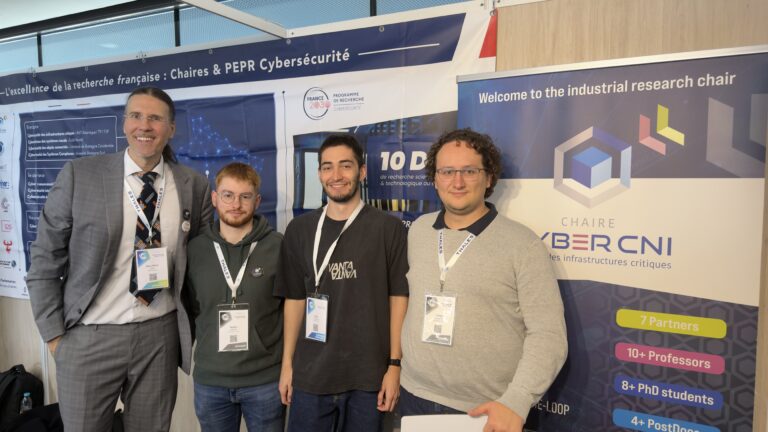
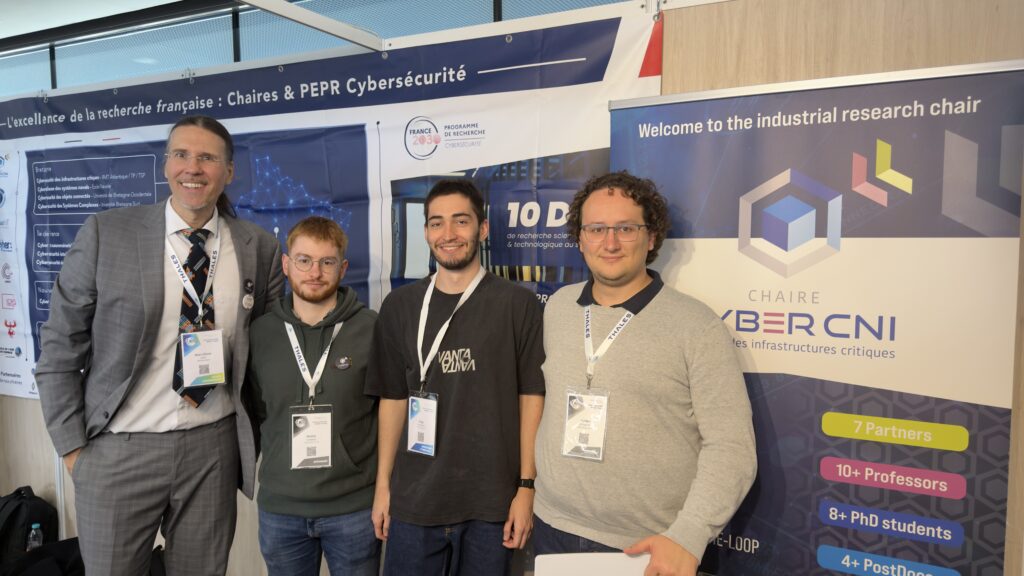
Four live research demonstrations at our stand, three conference contributions and countless inspiring conversations: Cyber CNI played a particularly active role in animating the scientific programme at European Cyber Week 2026. It was a tremendous collective success, with exciting opportunities for new collaborations ahead. Throughout the week in Rennes, our team showcased research in action, met potential partners and advanced discussions about the next generation of cybersecurity for critical national infrastructures.
From 16 to 19 November, European Cyber Week (ECW) brought together cybersecurity practitioners, public institutions, industry, defence organisations and researchers at the Couvent des Jacobins in Rennes. At our joint stand with COMCYBER and the other research chairs, Cyber CNI did more than exhibit: we actively helped bring the event to life through live demonstrations, discussions with visitors and contributions across the conference programme. As a proud member of the Pôle d’Excellence Cyber (PEC), we are delighted to play such an active role in this vibrant ecosystem, connecting academic research with industry, institutions and defence. Our thanks go to everyone who came to explore our research, ask questions, share challenges or discuss opportunities to work together.
Four demonstrations: seeing research in action
On 17 and 18 November, visitors to our stand explored four demonstrations representing different dimensions of Cyber CNI’s research:
- Industrial cybersecurity and hands-on training — Axel Dupraz and Marc-Oliver Pahl presented a cyberrange for operational technology (OT), featuring six progressive hands-on laboratories, reusable Docker-based environments and the possibility of connecting virtual systems to real industrial programmable logic controllers (PLCs). Discover the platform and its educational approach.
- Realistic honeynets — Mathis Durand and Marc-Oliver Pahl demonstrated how deceptive environments help observe attackers’ behaviour, and why their realism matters for scientific research on intrusion detection.
- Fully decentralized incident response — Luc Bournaud and Marc-Oliver Pahl discussed how systems can coordinate and respond to attacks even when centralized control mechanisms become unavailable.
- Virtual reality and immersive cybersecurity interfaces — Fabien Eyssartier and Marc-Oliver Pahl demonstrated the potential of extended reality (XR) for incident understanding, collaboration and security operations, including research within the European CyberSecDome project.
Together, these demonstrations reflect our approach: start from real-world challenges, develop rigorous scientific methods, and evaluate them in realistic experimental environments. Explore our experimental facilities for more examples.
Three conference contributions: disinformation, space cybersecurity and AI
Cyber CNI also contributed to three highlights of the ECW scientific programme:
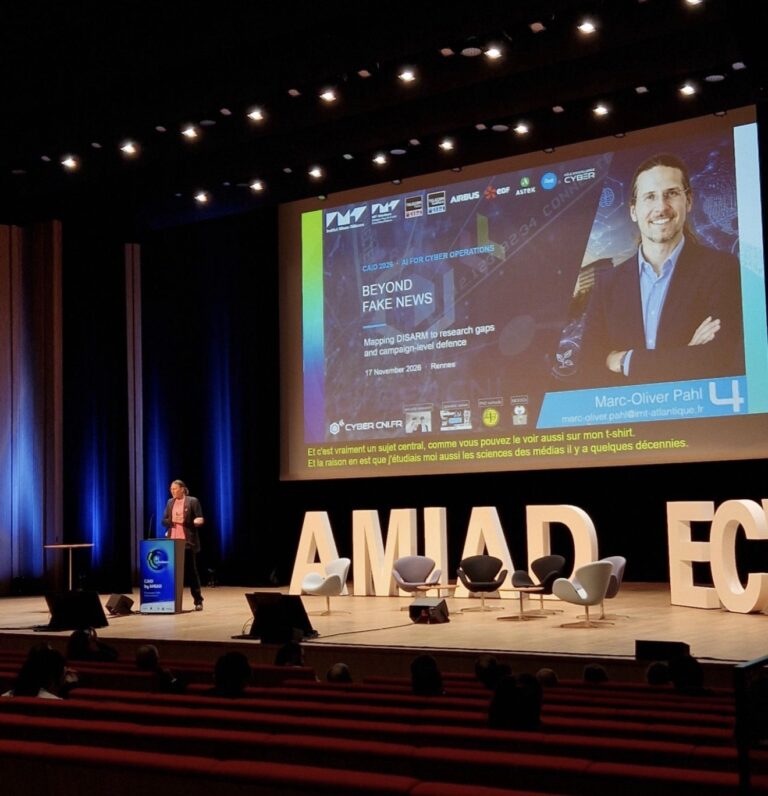
- CAID conference, 17 November: in “Beyond Fake News: Defending Against AI-Driven Influence Operations”, Marc-Oliver Pahl argued that defence must address the entire lifecycle of influence campaigns, rather than merely checking individual posts, drawing in particular on the DISARM framework. Read the key messages.
- Space cybersecurity, 19 November: Marc-Oliver Pahl joined a panel discussion on the supply chains supporting space systems, their dependencies and the implications for trust and resilience.
- Cybersecurity research chairs session, 19 November: the talk “AI and Cybersecurity” presented the chair’s research perspectives on artificial intelligence, collaborative detection, autonomous incident response and meaningful human oversight.
These contributions connected our research with defence priorities, digital sovereignty, industrial transformation and trust in digital systems. See Cyber CNI’s complete ECW 2026 programme.
Inspiring conversations, new contacts and partnerships ahead
Beyond our demonstrations and presentations, the remarkable number and quality of conversations made this event especially rewarding. We exchanged ideas with industrial companies, institutions, research teams, prospective PhD researchers and cybersecurity professionals. These discussions connected our results with emerging needs and helped identify shared research questions, experimental opportunities and promising areas for cooperation.
We now look forward to deepening the many new contacts made during ECW, exploring new industrial partnerships, collaborative projects and joint research, and continuing the fruitful conversations with our existing partners. Connecting new relationships with established collaborations and long-term research is what makes our engagement in the French and European cybersecurity ecosystem so valuable.
disinfo.science: a growing international research community
Our conversations on disinformation and influence operations also generated substantial interest. The open initiative disinfo.science aims to make disinformation research more visible, identify complementary expertise and connect research communities that often study different aspects of the same problem.
This interest is also reflected in new contributions and contacts around the Disinformation Research Atlas. Our ambition is to continue expanding this open map of research and expertise, while recognising that it is not an exhaustive census of worldwide activity.
🌍 Take part in disinfo.science
Researching disinformation, information manipulation, influence operations or potential countermeasures? Add your researcher profile, team or project to our open Research Atlas to make your work discoverable and connect with new collaborators.
Contribute to the Research Atlas →A Steering Committee meeting to prepare the chair’s next steps
European Cyber Week also provided the occasion for the Cyber CNI Steering Committee (COPIL) to meet on Wednesday, 18 November. Together with our academic, institutional and industrial partners, we reviewed the chair’s activities and exchanged views on research priorities and future directions.
Phase IV (2025–2028), supported by Airbus, EDF, Astek and RTE, reflects continuing scientific development and the growth of our partnerships. The COPIL provided an important opportunity to discuss our research orientations, prepare upcoming steps and collectively shape the chair’s future.
Thank you—and see you again around our next joint project
A huge thank you to the organisers of European Cyber Week for such an excellent event! Our thanks also go to the Pôle d’Excellence Cyber (PEC), of which we are proud members, to COMCYBER, our colleagues, researchers, partners and everyone we had the pleasure of meeting. We were delighted to contribute so actively to the event and look forward to following up with new contacts and continuing the fruitful exchanges with our partners.
Are you tackling an industrial cybersecurity challenge, preparing a collaborative research project, considering joining our partner ecosystem, or looking for a PhD or postdoctoral opportunity? We would be delighted to continue the conversation.
👉 Our partners · Research programme · Opportunities · Get in touch: hello@cybercni.fr
Lire également la version française de cet article / Read this article in French.

€5M+ funding | 60+ publications | 21+ PhD researchers | 300+ supervised students | 20,000+ learners
I explore how cybersecurity, artificial intelligence, distributed systems, and human-centered design can help build digital infrastructures that remain secure, resilient, and trustworthy as they become increasingly autonomous.
As Full Professor of Cybersecurity at IMT Atlantique and Chairholder of Cyber CNI, France’s largest industrial cybersecurity research chair, I work with industry, government, and academia to shape the next generation of resilient digital infrastructures.
My work bridges fundamental research and operational practice, spanning critical infrastructure protection, trustworthy AI, cyber-physical resilience, federated and collaborative security, immersive human–AI cyber operations, and autonomous response systems.
I am particularly interested in how humans and intelligent systems can collaborate to achieve trustworthy autonomy—transforming cybersecurity from reactive protection toward adaptive, resilient, and ultimately self-healing infrastructures.
- European Cyber Week 2026: A Great Success for Cyber CNI and New Partnerships Ahead - November 19, 2026
- European Cyber Week 2026 : un franc succès pour la Chaire Cyber CNI, et de nouvelles collaborations en perspective - November 19, 2026
- Beyond Fake News: Defending Against AI-Driven Influence Operations - November 18, 2026