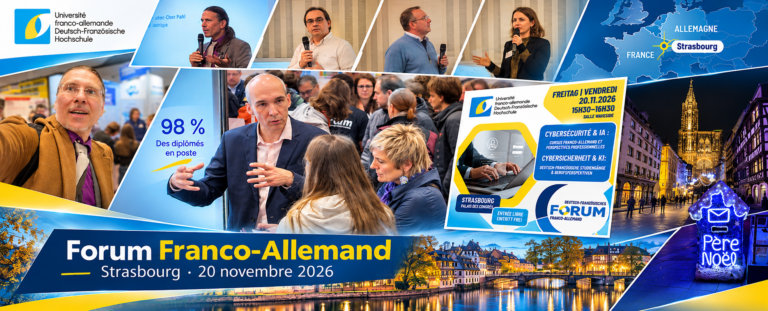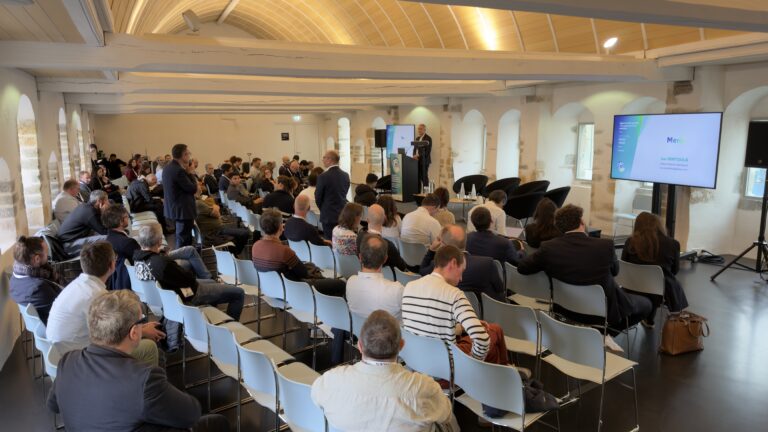
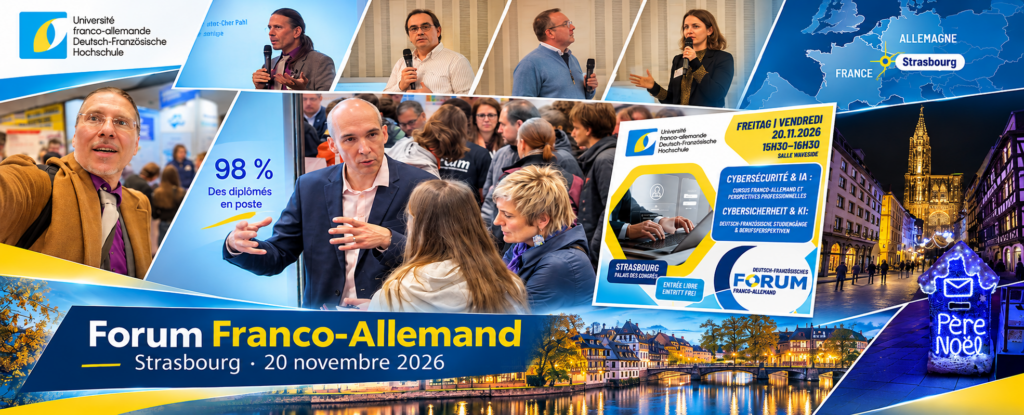
Without cybersecurity, our digital society cannot keep functioning. That was the central message I had the pleasure of sharing in Strasbourg on 20 November 2026, during the Franco-German Forum. The special session “Cybersecurity & AI: Franco-German degree programmes and career perspectives”, hosted with the Franco-German University (DFH/UFA), offered a wonderful opportunity to discuss trust on the Internet, artificial intelligence and how students can contribute to real security solutions already during their studies.
One of my strongest impressions was the interest of so many young people in explicitly Franco-German education. They were curious about crossing borders, discovering different academic approaches and building their futures together. Our conversations were inspiring — and they made Franco-German friendship tangible, not merely an aspiration.
Who can we still trust on the Internet?
In an exchange with a student around this question, I argued that cybersecurity is no longer a technical add-on. It is a fundamental requirement for our society to function. Hospitals, electricity networks, transport systems, public administrations and businesses all depend on tightly interconnected digital infrastructure. Attacks can therefore compromise entire services, rather than just individual computers.
This is precisely why the Cyber CNI Industrial Research Chair on Cybersecurity for Critical National Infrastructures works closely with academic and industrial partners on detecting attacks, understanding them, responding effectively and restoring essential operations. We must design security into systems from the very beginning — security by design — rather than try to bolt it on afterwards.
Artificial intelligence changes the rules for attackers and defenders
AI is accelerating cybersecurity on both sides. Attackers can automate, personalise and scale phishing, voice impersonation, deepfakes and social engineering. Defenders can use AI to examine large volumes of data, identify anomalies and connect signals that would be difficult to assess manually.
Our research into trustworthy autonomous cybersecurity aims to develop systems that can recognise, understand and increasingly defend themselves against attacks. Yet autonomy must never mean an absence of accountability. Human beings must remain responsible for consequential decisions, and AI-generated results must be critically assessed rather than blindly trusted.
For me, disinformation is among the most consequential societal impacts of generative AI today. The problem is not limited to isolated fake news items. AI can enable highly personalised, large-scale influence campaigns that erode our shared factual basis and make collective decision-making harder. Through disinfo.science, we seek to bring researchers together and better understand the complete chain of these attacks, not merely detect individual false claims. Trust must become something we can verify.
Cybersecurity needs every discipline — and the next generation
Cybersecurity is far more than hacking or programming. Everyone needs a basic understanding of cybersecurity, and our field needs people with backgrounds in engineering, health, psychology, law, communication, management and many other disciplines. Specialists will go deeper, but cyber awareness belongs to all of us.
My own teaching philosophy is based on learning by doing: experimenting, understanding mistakes, testing assumptions and developing independent judgement. This has driven the iLab teaching approach I developed at the Technical University of Munich, alongside cyber ranges and practical exercises grounded in real-world problems. Students do not have to wait until graduation to make a meaningful contribution.
Choosing cybersecurity is not just choosing a career with a future. It is helping to ensure that society has a future.
Franco-German collaboration as an engine for Europe
Strasbourg and the border region between France and Germany offer a compelling example of what two countries can achieve when they combine their strengths. Their scientific cultures, educational systems, institutions and industrial ecosystems have different traditions — and those differences can become a major source of creativity. Working across borders allows us to develop solutions that neither side would reach quite the same way alone.
For Cyber CNI, this matters directly: protecting critical infrastructures, building dependable digital systems and developing responsible AI are challenges that do not stop at national boundaries. Joint degrees, international mobility, cross-border teaching and collaborative research prepare people not only with technical knowledge, but with the ability to work across cultures and institutions. This is how Franco-German collaboration can help drive European innovation and resilience.
Inspiring discussions — and heartfelt thanks
The session opened with a presentation by Prof. Dr. Reinhard Brocks (HTW Saar), followed by Prof. Lionel Brunie (INSA Lyon), who introduced the joint Franco-German master’s programme in computing with the University of Passau. I then had the pleasure of discussing Internet trust with a student, before Prof. Vincent Heuveline (Heidelberg University) shared his perspective on career opportunities in cybersecurity, AI and high-performance computing. Thank you all for the interesting perspectives and discussions.
My sincere thanks go to Philippe Gréciano, President of the Franco-German University, and Andrea von Hülsen-Esch, its Vice-President and President of the Franco-German Forum, for the invitation. I am equally grateful to the teams of the DFH/UFA and the Franco-German Forum for organising such an important event.
Special thanks to Axel Honsdorf, Director of BayFrance, for his warm support and accompaniment, and to Mathilde Pareau, scientific policy officer of the French Embassy in Germany at BayFrance, for her excellent preparation and thoughtful moderation of our session.
Thank you all for your wonderful, continuing commitment to Franco-German friendship. This Forum was another opportunity to see that friendship being lived every day — through students, teachers, institutions and joint initiatives. Such exchanges can be a powerful engine for a strong and resilient Europe.
€5M+ funding | 60+ publications | 21+ PhD researchers | 300+ supervised students | 20,000+ learners
I explore how cybersecurity, artificial intelligence, distributed systems, and human-centered design can help build digital infrastructures that remain secure, resilient, and trustworthy as they become increasingly autonomous.
As Full Professor of Cybersecurity at IMT Atlantique and Chairholder of Cyber CNI, France’s largest industrial cybersecurity research chair, I work with industry, government, and academia to shape the next generation of resilient digital infrastructures.
My work bridges fundamental research and operational practice, spanning critical infrastructure protection, trustworthy AI, cyber-physical resilience, federated and collaborative security, immersive human–AI cyber operations, and autonomous response systems.
I am particularly interested in how humans and intelligent systems can collaborate to achieve trustworthy autonomy—transforming cybersecurity from reactive protection toward adaptive, resilient, and ultimately self-healing infrastructures.
- Cybersecurity and Franco-German cooperation: educating for a resilient Europe - November 27, 2026
- Cybersécurité et coopération franco-allemande : préparer ensemble l’avenir - November 27, 2026
- Space Cybersecurity: Securing the Supply Chain from Supplier Trust to Mission Resilience - November 20, 2026