Space infrastructure underpins communications, navigation, Earth observation and defence operations. Yet its cybersecurity depends on far more than the spacecraft: it relies on complex networks of suppliers, electronics, software, ground stations, digital services and organizations.
How can trust be established across this supply chain? How can technological dependencies be managed throughout a satellite’s operational life? And how can Europe strengthen technological sovereignty without slowing New Space innovation?
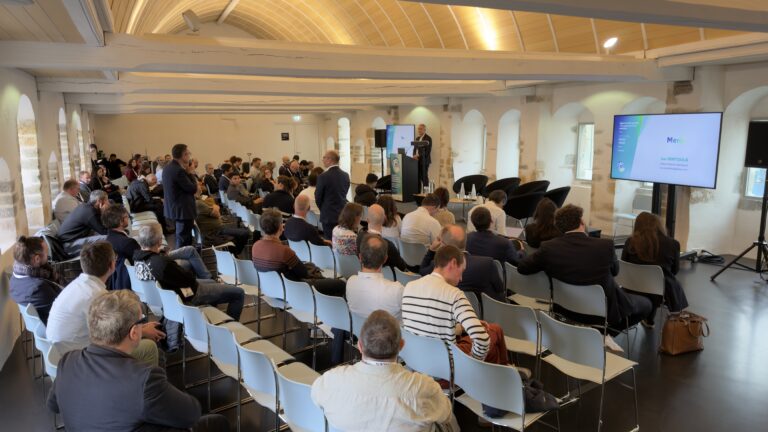
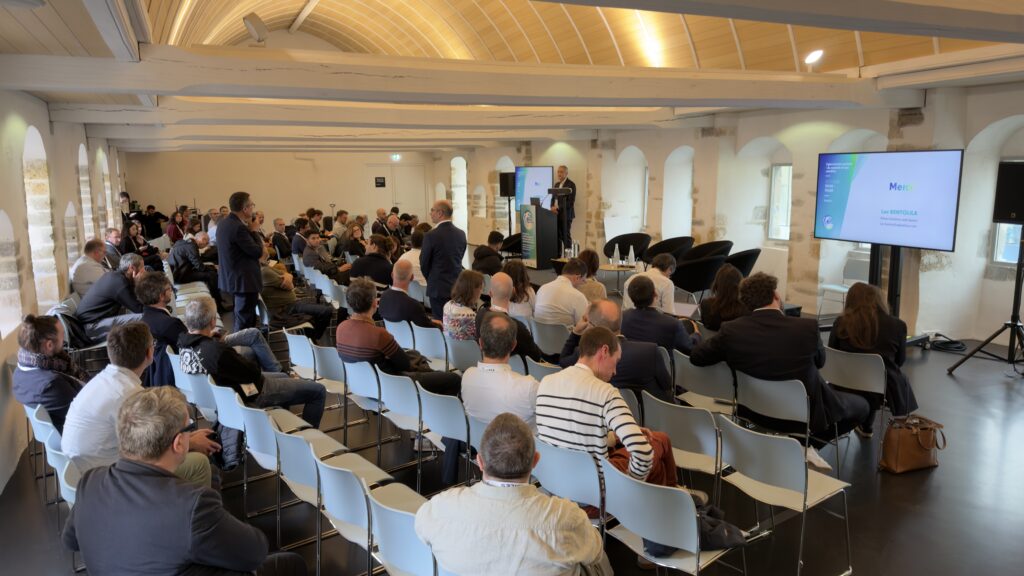
These questions shaped the roundtable “Space Supply Chain: A Key Area for Cyber Vigilance” at European Cyber Week in Rennes on 19 November 2026. Moderated by Sabrina Barré (Space Consultant, DragonFly Partners), the discussion brought together Antoine Hautin (Secretary General and VP Defence, Almond), Marc-Oliver Pahl (IMT Atlantique / Cyber CNI), Franck Perrin (Director of Space Development, Thales), and Stefan Tibar (French defence procurement agency, DGA).
One overarching message emerged: securing individual components does not automatically secure the complete system. Trust must be established, verified and maintained across suppliers, technologies and operators throughout the mission lifecycle.
What does the Space Sector Cybersecurity Observatory actually reveal?
The discussion opened with findings from the Space Sector Cybersecurity Performance Observatory, presented by Antoine Hautin in the context of the Pôle d’excellence cyber’s Cyber & Space working group. Using Board of Cyber’s Security Rating® platform, the study assessed the externally visible digital exposure of 170 organizations in the space value chain.
The panel averaged 705 points out of 1,000, compared with 725 in the broader reference population. Of the 170 organizations, 161 received an intermediate or advanced rating, while approximately 91% had at least one finding classified as high or critical severity. Crucially, that does not mean 91% had a confirmed, exploitable critical vulnerability.
The Observatory examines Internet-facing services and configurations, including email security, certificates, web technologies, exposed services and potential vulnerabilities. It is neither a comprehensive audit of those organizations nor an assessment of satellites, flight software or integrated space missions. Its results are nuanced: the space panel scores below the reference population on some indicators, including vulnerabilities, but better on the patching indicator.
This distinction matters scientifically. Ratings of individual suppliers do not reveal every software dependency, maintenance interface or integration-induced risk. A complementary research challenge is to connect organizational exposure and component dependencies to their potential consequences for mission functions.
Technology dependencies: verify, replace, and maintain operation
European space programmes depend on highly specialized supply chains. Electronic components, embedded software, communications equipment, digital services and development tools may come from a small number of suppliers, including outside Europe.
Stefan Tibar of the French defence procurement agency (DGA) emphasized risk-based decisions reflecting the criticality of individual functions. Supplier nationality alone is not a sufficient measure of security; what matters is also the ability to control a dependency and manage its consequences.
Marc-Oliver Pahl proposed three capabilities for managing critical dependencies: verify what a supplier delivers and how it behaves; replace a component or supplier when necessary; and maintain essential operation if a dependency is compromised or unavailable. These capabilities depend on modularity, interoperability, interface control and resilience. Technological sovereignty is ultimately about preserving the ability to act.
Compliance, certification, and verifiable trust
The panel discussed France’s Fundamental Cyber Maturity Framework (RMC-F), which helps structure cybersecurity expectations across the defence industrial and technological base. Self-assessments, contractual requirements and audits are useful mechanisms for assigning responsibility and improving baseline practices.
Yet a compliant supplier does not automatically produce a secure integrated system. Components assessed separately may interact in unexpected ways, and a configuration deemed secure at delivery may become vulnerable following an update or a new attack technique.
Cyber CNI’s perspective is to complement periodic assessments with trust that can be verified throughout operation: observing system behaviour, detecting anomalies and comparing evidence from independent sources. This does not replace standards; it helps establish what assurance actually means as a system evolves.
Assembly, integration, and testing: a risk and an opportunity
During assembly, integration and testing, teams from multiple organizations may access the same equipment. Diagnostic interfaces, development systems, test infrastructure and embedded software create a dense network of privileges and trust relationships. Access control and traceability are essential.
Marc-Oliver Pahl emphasized the dual nature of this phase. Integration can introduce new vulnerabilities when individually assessed components interact, but it is also a valuable opportunity for physical inspection and testing—opportunities that become much more limited after launch. Testing should therefore address the integrated system, and observability should be designed in before deployment.
Maintaining trust over a satellite’s lifetime
Spacecraft may operate for many years while their software dependencies, suppliers and the vulnerability landscape change. Managing dependencies cannot end with delivery.
Software Bills of Materials (SBOMs) help document components and identify those potentially affected by newly disclosed vulnerabilities. But an inventory alone cannot establish whether a vulnerability is exploitable in a particular operational configuration.
Dependency information must be connected to operational context and to observability capabilities incorporated at design time. Software, network and—in suitable systems—hardware-derived evidence can support diagnosis when physical access is no longer possible.
Updates in orbit: cybersecurity meets safety engineering
Software updates can eliminate vulnerabilities but also introduce defects or disrupt critical functions. Even an authentic, correctly signed update is not necessarily safe for a mission.
Communication constraints, limited resources and physical inaccessibility complicate the trade-off between leaving a vulnerability unpatched and modifying a spacecraft in orbit. Representative testing, rollback mechanisms where feasible, and post-update verification are essential.
This is where cybersecurity meets safety engineering. Research on cyber-physical systems, digital twins and resilience can help evaluate the operational consequences of changes and preserve essential mission functions.
New Space: collaboration as a driver of security and innovation
New Space companies bring agility and innovation, but cybersecurity assessment, qualification and infrastructure can be costly for smaller firms. The panel cautioned against treating security and innovation as opposing goals.
Marc-Oliver Pahl argued for collaboration as shared responsibility: failure of one component may affect the final product, its users and the reputations of multiple organizations. Cybersecurity should not merely be a requirement imposed downstream by a prime contractor; it is a common interest of suppliers, integrators and operators.
Franck Perrin of Thales likewise highlighted cooperation between established industrial groups and innovative companies. Established qualification capabilities and integration experience can complement the speed of startups. Shared expertise, testing environments and practices can raise security standards without excluding SMEs.
Digital sovereignty: invest and preserve alternatives
Audience questions broadened the discussion to European dependence on foreign software, electronics and AI technologies. In a changing geopolitical environment, continued access to technology, updates and support can become strategically significant.
Stefan Tibar emphasized prioritizing the most critical dependencies. Franck Perrin noted the possible effects of geopolitical developments on industrial supply chains, while Antoine Hautin drew parallels with other critical infrastructure sectors.
Marc-Oliver Pahl argued for combining investment in European capabilities with architectures that allow substitution. The objective is not to reject international innovation, but to avoid irreversible dependencies through modularity, interoperability and control of interfaces. Sovereignty requires long-term strategy alongside immediate risk management.
Research perspectives: from component protection to mission resilience
The discussion closely connects to Cyber CNI research on distributed-system security, anomaly detection, cyber-physical observability, collaborative AI and incident response. Space infrastructures combine constrained embedded platforms, terrestrial and orbital networks, software dependencies, intermittent communications and limited opportunities for physical intervention.
Three research directions stand out. Understand dependencies and consequences: connect component inventories, provenance and interactions to mission functions. Establish verifiable trust: correlate software, network and physical observations to detect anomalies while distinguishing attacks from faults. Develop resilience: design containment, recovery and, where appropriate, autonomous response mechanisms that respect safety constraints.
No single discipline can solve these problems alone. They call for close collaboration among cybersecurity, distributed systems, aerospace engineering, safety engineering and industrial partners. The goal is not merely to secure each component but to maintain trustworthy mission operation even when parts of the system fail or are compromised.
A collective responsibility for Europe’s space ecosystem
Despite their different perspectives, the speakers converged on several needs: understand dependencies, build security into design, complement compliance with technical verification, support innovative suppliers and invest in sustainable technological alternatives.
Space supply-chain resilience depends as much on cooperation among stakeholders as on technical safeguards. Suppliers, integrators, operators, public authorities and researchers bring complementary capabilities for sharing knowledge, improving practices and developing mission-relevant solutions.
For Cyber CNI, the central question is: how can we maintain trust and resilience across an entire system when some of its components or suppliers are vulnerable?
We warmly thank Sabrina Barré (DragonFly Partners) for moderating the discussion, and Antoine Hautin (Almond), Franck Perrin (Thales) and Stefan Tibar (DGA) for their contributions. We also thank the European Cyber Week organizers and the Pôle d’excellence cyber for enabling this dialogue. We look forward to continuing the exchanges and developing new collaborations across research, industry and public institutions.
Further reading
- Pôle d’excellence cyber / Board of Cyber (2026), Space Sector Cybersecurity Performance Observatory (170 organizations; data as of 6 October 2026).
- ECSS-E-ST-80C (2024), Space Engineering – Security.
- Cyber CNI Research Chair · Pôle d’excellence cyber

€5M+ funding | 60+ publications | 21+ PhD researchers | 300+ supervised students | 20,000+ learners
I explore how cybersecurity, artificial intelligence, distributed systems, and human-centered design can help build digital infrastructures that remain secure, resilient, and trustworthy as they become increasingly autonomous.
As Full Professor of Cybersecurity at IMT Atlantique and Chairholder of Cyber CNI, France’s largest industrial cybersecurity research chair, I work with industry, government, and academia to shape the next generation of resilient digital infrastructures.
My work bridges fundamental research and operational practice, spanning critical infrastructure protection, trustworthy AI, cyber-physical resilience, federated and collaborative security, immersive human–AI cyber operations, and autonomous response systems.
I am particularly interested in how humans and intelligent systems can collaborate to achieve trustworthy autonomy—transforming cybersecurity from reactive protection toward adaptive, resilient, and ultimately self-healing infrastructures.
- Space Cybersecurity: Securing the Supply Chain from Supplier Trust to Mission Resilience - November 20, 2026
- Cybersécurité spatiale : sécuriser toute la chaîne de valeur, de la confiance dans les fournisseurs à la résilience des missions - November 20, 2026
- European Cyber Week 2026: A Great Success for Cyber CNI and New Partnerships Ahead - November 19, 2026