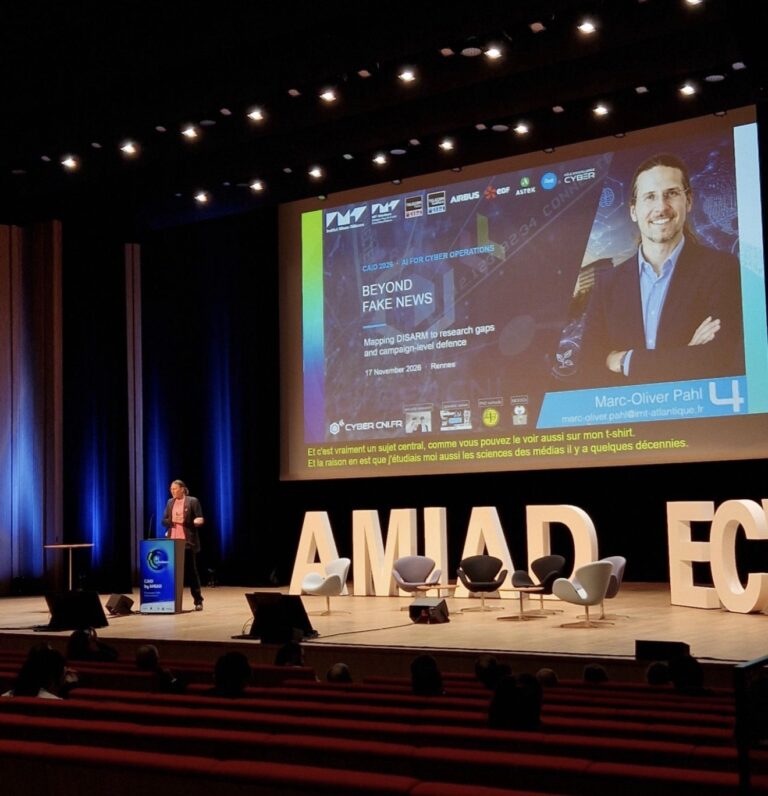
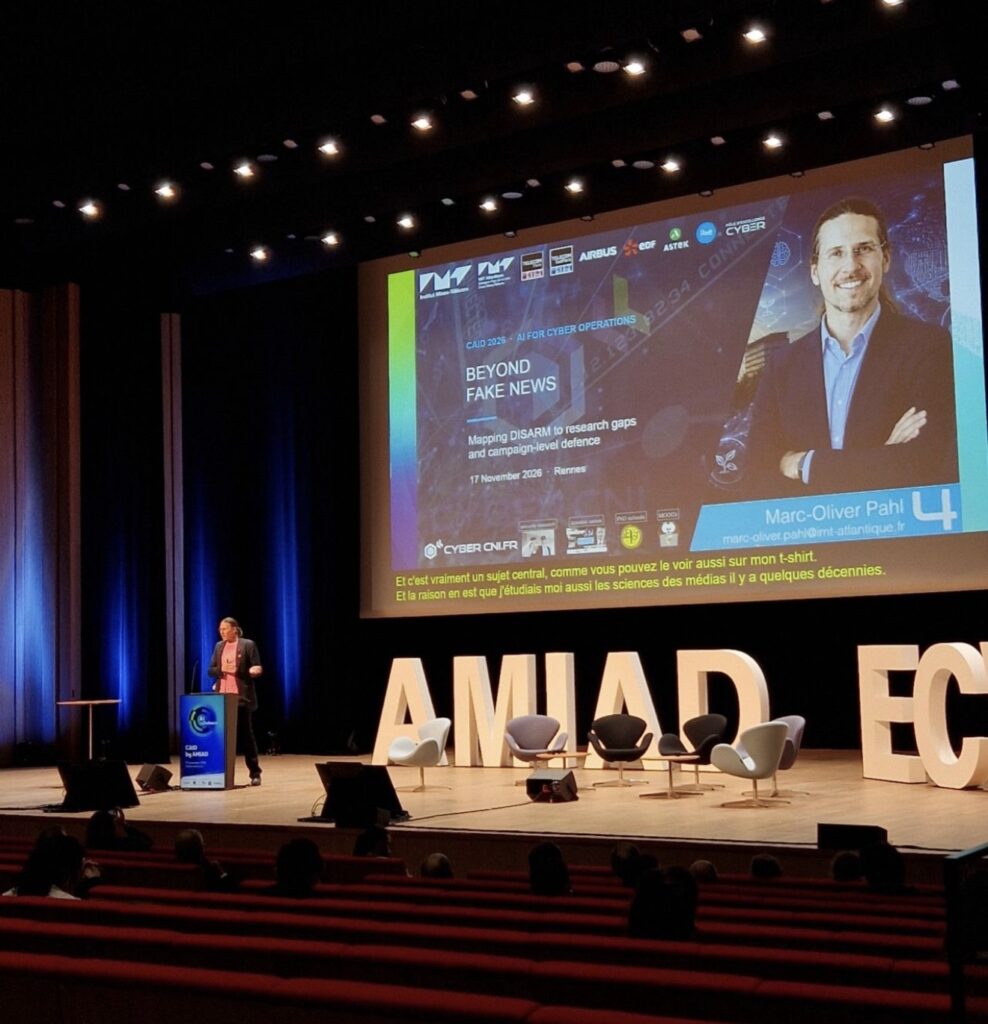
What if every message in a disinformation campaign looked credible—or even contained factually accurate information? Would detecting “fake news” still be enough to protect us? That was the question raised by Marc-Oliver Pahl, Chairholder of Cyber CNI at IMT Atlantique, in his talk “Beyond Fake News: Defending Against AI-Driven Influence Operations” on 17 November 2026 at the CAID conference in Rennes.
His central argument: we must shift our attention from isolated pieces of content to entire influence campaigns, including their preparation, dissemination and adaptation. Generative AI does not merely increase the volume of misleading material; it may also facilitate the organization, personalization and evolution of an entire operation.
🌍 Take part in disinfo.science
Researchers, teams and institutions: add your research profile or project to our open Research Atlas. Make your work discoverable, find complementary expertise and help build an international community tackling disinformation. You do not need to belong to a funded project to take part.
Add your profile or project to the Research Atlas →European Cyber Week and CAID: where research, defence and industry meet
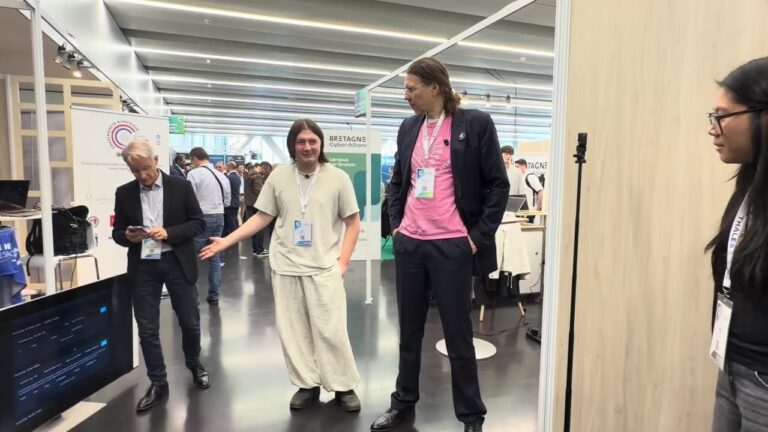
From 16 to 19 November 2026, European Cyber Week (ECW) brings together French and European stakeholders in cybersecurity and defence AI at the Couvent des Jacobins in Rennes: civilian and military institutions, companies, startups and academia. The event creates a forum to connect operational needs, innovation, research and digital sovereignty.
Within this setting, the Conference on Artificial Intelligence for Defence (CAID) takes place on 17 and 18 November. Organized by France’s Ministerial Agency for Defence Artificial Intelligence (AMIAD), its eighth edition focuses on operational requirements and AI capabilities. Cyber CNI’s presentation featured in the “AI for Cyber Operations” session on Tuesday, 17 November, from 15:00 to 15:15. See the CAID programme.
1. The question is not only whether a message is true
Consider a hypothetical example: several messages reach military personnel and their families. Taken individually, each seems plausible; some even report accurate facts. But together they could be part of a coordinated operation intended to influence perceptions or decisions.
A system that checks only the truthfulness of each post could miss the central question: who is targeting which audience, through which intermediaries, for what purpose, and how does the narrative evolve in response to observed reactions? Conversely, similar messages alone do not prove malicious coordination. Every hypothesis requires observable, appropriately qualified evidence.
2. DISARM: analysing influence operations throughout their lifecycle
The talk uses the DISARM Red Framework to structure this problem. It describes influence operations across four broad phases and sixteen associated tactics:
- Plan: define an objective, identify and analyse target audiences.
- Prepare: build narratives, content, identities or seemingly credible information sources, and select channels.
- Execute: distribute, amplify, sustain or adapt the operation across channels.
- Assess: observe effects and adapt subsequent activities.
Generating a message is only one step in this lifecycle. Much of the preparation and targeting can take place before any public post appears, in private spaces or outside the platforms monitored by conventional tools. Defensive approaches need to account for these less visible activities.
3. Our research mapping reveals a mismatch between studied artefacts and defence needs
The synthesis presented at CAID mapped different research streams onto DISARM’s phases. Its technical basis included a corpus of 48 recent studies concerning offensive uses of and vulnerabilities in large language models, complemented by research and exchanges from our interdisciplinary Dresden workshop on generative AI and disinformation.
We find substantial research on content generation and verification, alongside growing interest in information propagation, coordinated agents and personalized persuasion. But approaches to reconstructing entire campaigns, identifying less visible targeting or measuring defensive interventions throughout the lifecycle remain fragmented.
This mapping is illustrative, not an exhaustive census of the literature. Nevertheless, it highlights a fundamental mismatch: research often measures model performance on individual messages or images, whereas operational defence needs to understand relationships, temporal evolution and adaptive campaigns.
4. disinfo.science: connecting research across disciplines
Relevant expertise is scattered across computer science, social science, communication, psychology, cybersecurity and defence studies. These communities often investigate different parts of the same problem. To make their work more visible and help them connect, we launched disinfo.science, an open research and networking resource focused on disinformation and information integrity.
Its Research Atlas supports the exploration of projects, institutions, research outputs and resources. It helps identify complementary expertise and potentially underconnected topics. As of 13 November 2026, it contained 115 published entries, institutions in 42 countries and 61 listed research outputs. These numbers describe the atlas at that date; they are not a representative measurement of all research worldwide.
Are you working on information manipulation, influence operations, detection tools or preventive interventions? The Research Atlas welcomes your contributions, whether you are an individual researcher or part of a funded project. Add your researcher profile, team or project now. An email verification code lets you submit and later update your entry. You can also browse existing research and discover potential collaborators.
5. Three priorities for more effective defence
Based on this assessment, the talk proposes three changes in perspective:
- Move earlier: investigate signals of emerging campaigns, including the preparation of assets, audience targeting and initial narrative shifts, instead of waiting until content is widely circulated.
- Look broader: connect content, accounts, conversations, interactions, dissemination networks, timelines and provenance rather than analysing just one platform or content format.
- Close the loop: help analysts interpret evidence, evaluate interventions and follow campaign adaptation rather than stopping at a detection score.
These shifts also require different scientific evaluation criteria: detection lead time, campaign-level precision and recall, confidence calibration and analyst workload. Missing observations are not evidence of hostile intent; data limitations must remain explicit.
6. A research architecture: connecting observations to verifiable hypotheses
To put these requirements into practice, we propose a candidate architecture with five stages:
- Observe heterogeneous sources: content, accounts, exchanges and events.
- Extract relevant information—including narratives, entities, potential targets and interactions—using natural-language processing and AI models.
- Link evidence using dynamic knowledge graphs and temporal analysis methods.
- Reason about campaign hypotheses by combining provenance, neuro-symbolic methods and DISARM’s operational structure.
- Keep the analyst in the loop: a human reviews the evidence, corrects interpretations, prioritizes investigations and decides whether intervention is justified.
This is not an operationally validated system. The architecture remains at the concept and early-component stage, at an estimated technology readiness level of TRL 2–3. Proposed countermeasures are hypotheses to be tested in realistic campaign scenarios with incomplete information and adaptive adversaries.
Defend the lifecycle, not just the post
The talk’s concluding message is simple: “Defend the lifecycle. Not just the post.” Generative AI may transform every stage of influence operations. Scientific responses must therefore combine attack-lifecycle analysis, evidence fusion, explainable reasoning, realistic experimentation and meaningful human oversight.
Next steps include controlled demonstrators and evaluation with defence users: detect earlier, support conclusions with stronger evidence, communicate uncertainty more accurately and reduce unnecessary analyst workload. Achieving this will require collaboration among researchers, industry, defence practitioners and the social sciences.
🌍 Join the community: contribute to the disinfo.science Research Atlas. Showcase your research, make your team discoverable and help connect approaches to information integrity across disciplines and borders. To propose a research project or collaboration on AI and cybersecurity, contact the Cyber CNI Research Chair at hello@cybercni.fr.
Further reading: European Cyber Week 2026 · CAID — Conference on Artificial Intelligence for Defence · CAID programme · Disinformation Research Atlas · Cyber CNI at ECW 2026.
Cet article est également disponible en français / Read the French version.

€5M+ funding | 60+ publications | 21+ PhD researchers | 300+ supervised students | 20,000+ learners
I explore how cybersecurity, artificial intelligence, distributed systems, and human-centered design can help build digital infrastructures that remain secure, resilient, and trustworthy as they become increasingly autonomous.
As Full Professor of Cybersecurity at IMT Atlantique and Chairholder of Cyber CNI, France’s largest industrial cybersecurity research chair, I work with industry, government, and academia to shape the next generation of resilient digital infrastructures.
My work bridges fundamental research and operational practice, spanning critical infrastructure protection, trustworthy AI, cyber-physical resilience, federated and collaborative security, immersive human–AI cyber operations, and autonomous response systems.
I am particularly interested in how humans and intelligent systems can collaborate to achieve trustworthy autonomy—transforming cybersecurity from reactive protection toward adaptive, resilient, and ultimately self-healing infrastructures.
- Beyond Fake News: Defending Against AI-Driven Influence Operations - November 18, 2026
- Au-delà des fake news : défendre les campagnes d’influence pilotées par l’IA - November 18, 2026
- Industrial Cybersecurity: Six Hands-on Labs for Learning by Experimenting - November 18, 2026