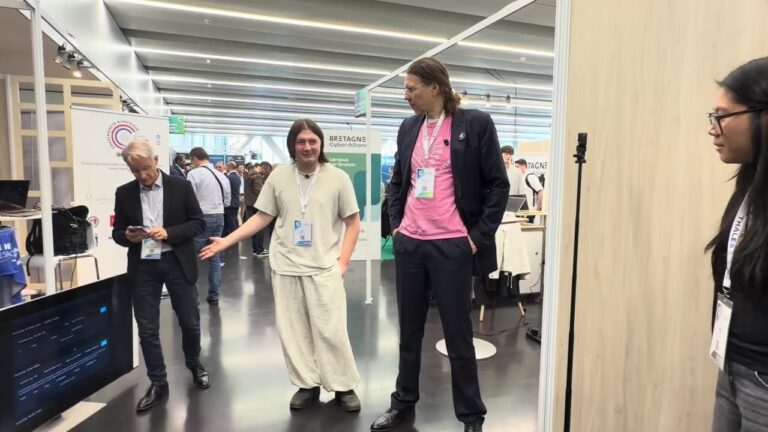
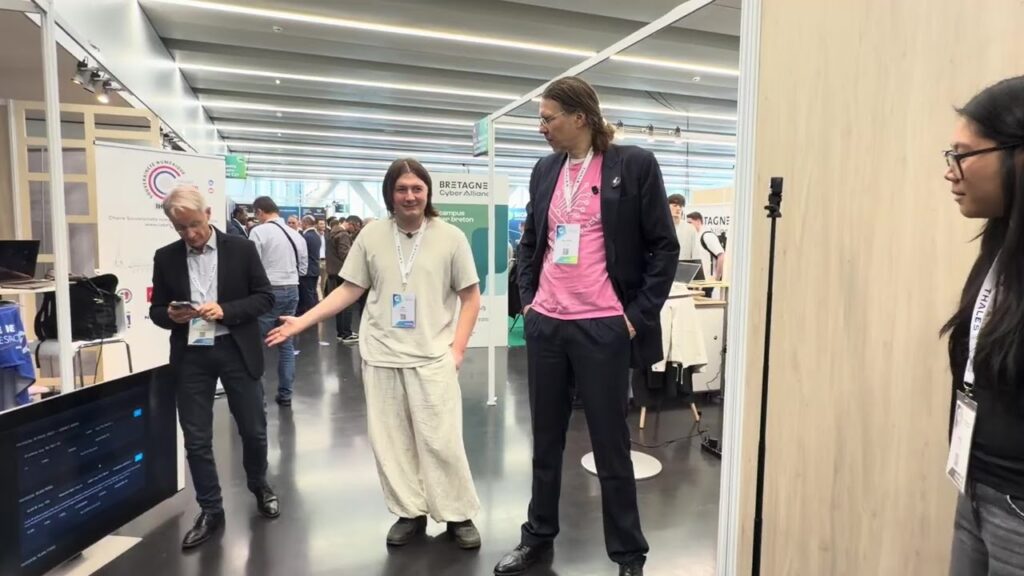
How can we teach students to protect an industrial installation without putting a real production line at risk? On Tuesday, 17 November 2026, at European Cyber Week in Rennes, Axel Dupraz, an engineer at IMT Atlantique, and Marc-Oliver Pahl, Chairholder of Cyber CNI, presented a practical answer: a cyberrange platform that lets students discover, understand and secure industrial systems through hands-on experimentation.
This first of four demonstrations by Cyber CNI at ECW 2026 took place at our joint stand with COMCYBER, on the first floor of the Couvent des Jacobins. The pedagogical objective is clear: make the complexity of operational technology (OT) environments accessible without sacrificing technical realism.
Why teach industrial cybersecurity differently?
Programmable logic controllers (PLCs), operator interfaces, sensors, actuators and supervisory systems control many essential processes, including manufacturing lines, energy facilities, refrigeration systems and other critical infrastructures. Protecting them is not simply a matter of securing a server or workstation. A digital action can have consequences for a physical process.
Yet reproducing these environments is expensive, and manipulating them in a training context can be difficult. Their architectures are complex, students do not always have access to the necessary equipment, and configuration problems can consume precious teaching time. Axel Dupraz and Marc-Oliver Pahl therefore developed an approach that puts exploration and security decisions at the centre of learning, rather than spending the session setting up tools.
A cyberrange in the browser, with nothing to install on students’ computers
Axel Dupraz developed the platform’s technical infrastructure, while the pedagogical scenarios and learning objectives are developed together with Marc-Oliver Pahl. A student simply opens a browser, signs into their workspace and launches a laboratory. Environments are deployed automatically from reusable templates, in particular using Docker containers.
Each participant receives their own network-isolated instance, allowing them to explore without interfering with others. The platform provides access to machine interfaces, terminals and analysis tools directly in the browser. Students can, for example, interact with an engineering workstation, examine a supervisory interface, or inspect network traffic with Wireshark and download packet captures for more detailed analysis.
Another important educational benefit: each laboratory starts in a known state, and instances are removed after use. Students can focus on the system under investigation rather than troubleshooting configuration changes left over from a previous session.
Six progressive labs: from an industrial controller to a complete system
The course currently comprises six exercises, with a seventh in preparation. The progression is straightforward: begin with a minimal industrial environment, then gradually introduce new components and new cybersecurity questions.
- Discover the basics: start with an industrial controller and a simple process to understand the interactions between a digital system and its environment.
- Add operational interfaces: introduce operator workstations and human–machine interfaces (HMIs) to see what they enable—and which risks they introduce.
- Build up the architecture: examine the role of an industrial data historian, interconnections and possible remote access.
- Move from observation to defence: assess risks, identify sensitive points, select mitigations and apply them in the experimental environment.
The initial steps follow a guided scenario; students are then given increasing freedom to explore. The goal is not to drop students into a huge industrial architecture immediately, but to help them progressively develop an operational understanding until they can use the relevant tools more independently.
From virtual to physical: connecting the exercises to real equipment
The platform is not limited to simulation. Its architecture supports the connection of real equipment, including industrial PLCs, to virtual environments. Network isolation, with a separate VLAN for each laboratory, makes it possible to associate a physical device with a particular instance. Participants can then see how a command sent from a virtual interface affects a physical process.
This hybrid setup has already been tested with an industrial PLC. The next step is further validation with more equipment and several students connected simultaneously. This remains an important development stage: the platform is intended to support larger teaching groups, but the tests completed so far should not be mistaken for a full validation of that scale.
The demonstration is part of Cyber CNI’s wider collection of experimental facilities, combining virtualized cyberranges, cyber-physical environments, honeypots and immersive interfaces for research and education.
A reusable infrastructure for teaching, research and industry
The value of the platform goes beyond its six current exercises. Deployment templates can describe other topologies, include suitable software images and expose different interfaces to users. The same infrastructure could therefore host other lab suites—even beyond industrial cybersecurity—provided the environments can be deployed virtually or connected to physical hardware.
This work forms part of a project supported through France 2030 and an ambition to share educational resources among the schools of the IMT group. It is also relevant to professional training and companies seeking to give staff practical experience with industrial security challenges. Wider dissemination, potentially through a MOOC, is among the possibilities being considered.
The platform is still evolving. Templates are currently configured using files and the accompanying documentation; a graphical interface for creating them could be explored in the future. Proprietary industrial protocols are not yet included in the available scenarios, although the architecture could support additional use cases with industry partners.
At ECW, an invitation to collaborate
Axel Dupraz’s presentation demonstrated how industrial cybersecurity can become tangible, progressive and experimental. Instead of merely discussing defences, students can see the components, understand the risks and try concrete measures. The platform also provides a promising environment for the scientific evaluation of OT and cyber-physical security methods.
Do you teach cybersecurity, operate industrial systems, or want to develop exercises, demonstrations or joint research projects? The Cyber CNI Research Chair welcomes exchanges with educational institutions, researchers and industrial partners.
📍 European Cyber Week 2026, Rennes: join the remaining Cyber CNI demonstrations at our shared stand with COMCYBER, on the first floor of the Couvent des Jacobins, on Wednesday, 18 November: decentralized incident response at 10:30 and immersive cybersecurity interfaces at 15:30. See the full programme.
👉 Explore our experimental facilities · Discover our research · Propose a collaboration · hello@cybercni.fr
Également disponible en français / Read the French version.

€5M+ funding | 60+ publications | 21+ PhD researchers | 300+ supervised students | 20,000+ learners
I explore how cybersecurity, artificial intelligence, distributed systems, and human-centered design can help build digital infrastructures that remain secure, resilient, and trustworthy as they become increasingly autonomous.
As Full Professor of Cybersecurity at IMT Atlantique and Chairholder of Cyber CNI, France’s largest industrial cybersecurity research chair, I work with industry, government, and academia to shape the next generation of resilient digital infrastructures.
My work bridges fundamental research and operational practice, spanning critical infrastructure protection, trustworthy AI, cyber-physical resilience, federated and collaborative security, immersive human–AI cyber operations, and autonomous response systems.
I am particularly interested in how humans and intelligent systems can collaborate to achieve trustworthy autonomy—transforming cybersecurity from reactive protection toward adaptive, resilient, and ultimately self-healing infrastructures.
- Beyond Fake News: Defending Against AI-Driven Influence Operations - November 18, 2026
- Au-delà des fake news : défendre les campagnes d’influence pilotées par l’IA - November 18, 2026
- Industrial Cybersecurity: Six Hands-on Labs for Learning by Experimenting - November 18, 2026