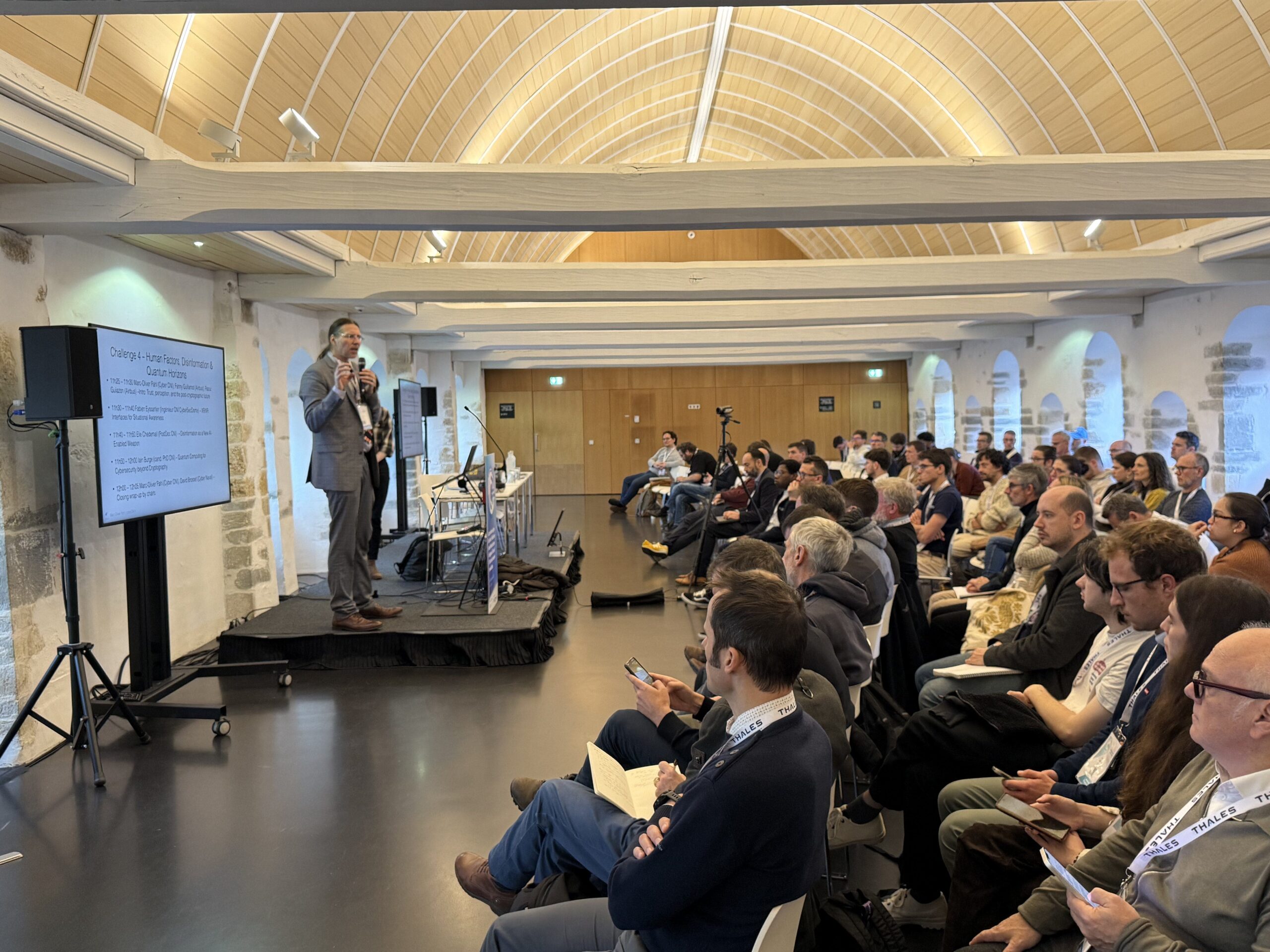
Conference recap : “The Next Front Line: Resilience of Critical Infrastructure in the Age of AI and Global Tensions”
The Cybersecurity for Critical Networked Infrastructure Chair (Cyber CNI) and the Naval Systems Cyber Defense Chair organized a morning session dedicated to critical infrastructure protection during the 10th edition of European Cyber Week. This event provided insight into how artificial intelligence, targeted attacks, and global tensions are transforming the security of essential systems. It provided a clear overview of the challenges currently facing the energy, transport, and maritime sectors.
Understanding new attacks
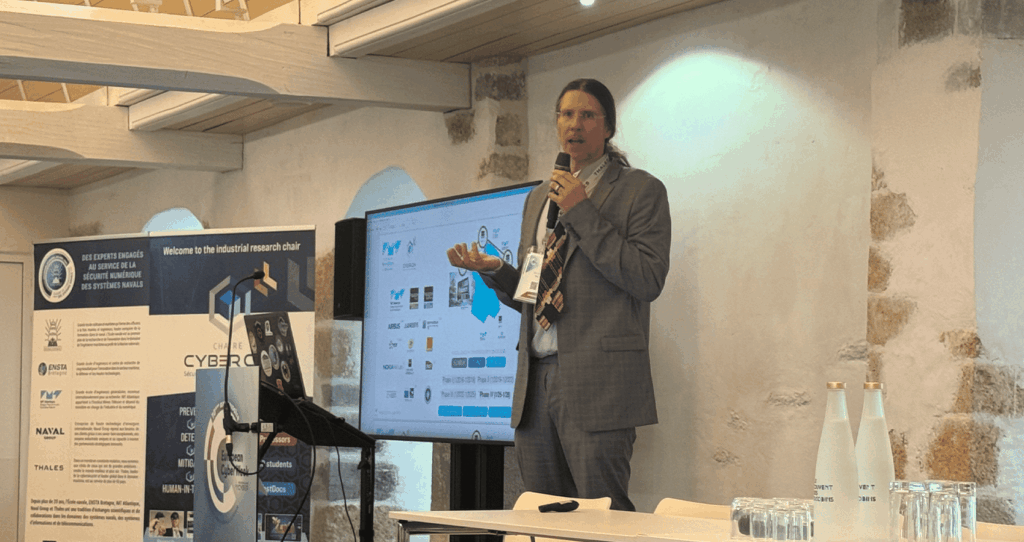
The conference began with Prof. Marc-Oliver Pahl, holder of the Chair in Cybersecurity for Critical Infrastructure, and Prof. David Brosset, holder of the Chair in Cyberdefense for Naval Systems. They pointed out that critical infrastructure is facing increasingly sophisticated attacks. Consequently, it is becoming important to anticipate attackers’ strategies.

Next, Mathis Durand (PhD student, Critical Infrastructure Cybersecurity) presented honeynets. These environments mimic real systems to attract cybercriminals. This allows researchers to observe their actions without risk. Then, Pierre-Louis Goudet (PhD student, Chair of Naval Systems Cyberdefense) explained how certain attacks still manage to bypass network protections. This point shows that current mechanisms need to be upgraded.
Building more secure systems
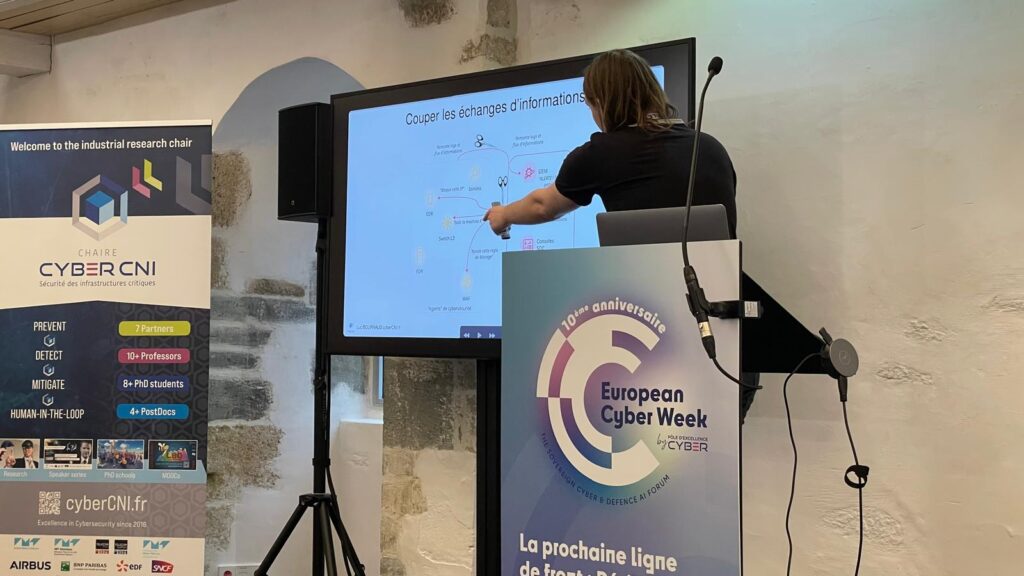
Several speakers then presented ways to strengthen security. First, Luc Bournaud (PhD student, Critical Infrastructure Cybersecurity) explained how decentralized defenses can respond more quickly to threats. Next, Luis Soeiro (PhD student, Critical Infrastructure Cybersecurity) demonstrated his method for automatically generating logical attack graphs. These graphs make it easier to assess the risks associated with the software supply chain.
In addition, Pierre Garreau (PhD student, Chair of Cyberdefense of Naval Systems) presented a solution that allows AI models to be run on very low-power devices. This approach paves the way for new uses, particularly for embedded cybersecurity.
AI and emerging risks
The second part of the morning focused on the challenges associated with AI. To begin with, Gabriel Dumont (PhD student, Chair of Cyberdefense of Naval Systems) presented a hybrid model capable of improving risk prevention. Next, Alexandre Azor, a PhD student from the same chair, described the dangers of data poisoning. This technique involves modifying training data to mislead a model, creating significant vulnerabilities.
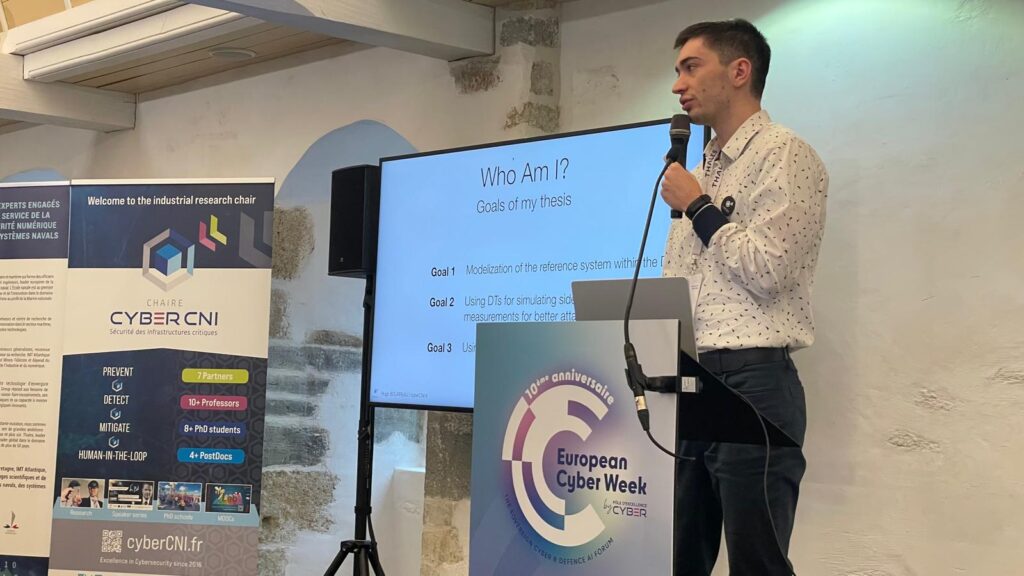
At the same time, Hugo Bourreau (PhD student, Critical Infrastructure Cybersecurity) presented digital twins. These digital twins reproduce real infrastructure. They can be used to simulate incidents without interrupting operations.
People at the heart of tomorrow’s challenges
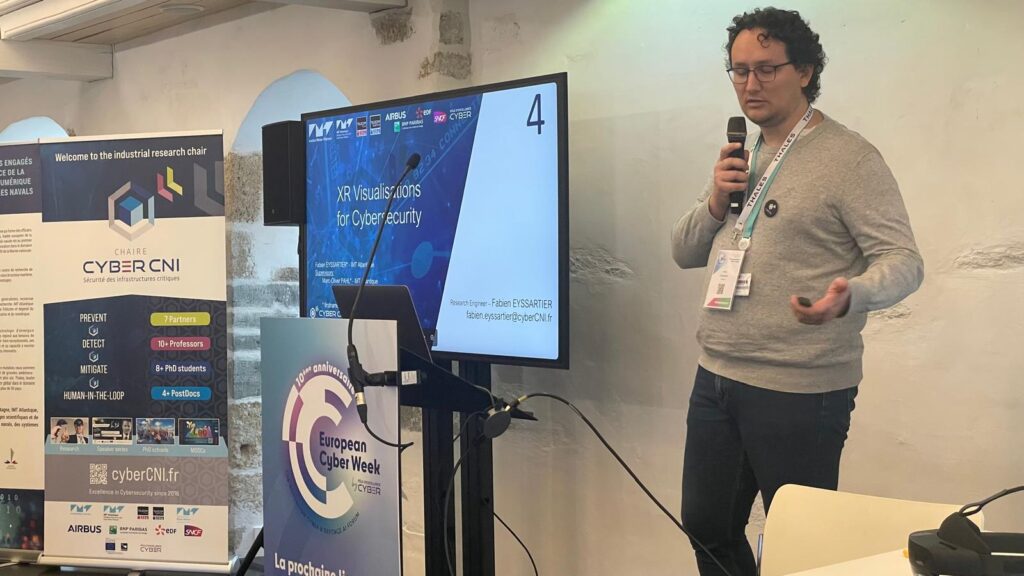
Finally, several presentations highlighted the importance of people. Fabien Eyssartier (Engineer, Critical Infrastructure Cybersecurity Chair) showed how XR and VR can help operators better understand their environment. Next, Elie Chedemail (PhD student, Critical Infrastructure Cybersecurity) and Alexander Loth (PhD student, Critical Infrastructure Cybersecurity), both PhD students in our chair, explained how disinformation is becoming more dangerous with AI. Finally, Iain Burge Chaire (PhD student, Critical Infrastructure Cybersecurity) presented the contribution of quantum computing to cybersecurity, beyond cryptography.
Collective mobilization to better anticipate the future
The morning concluded with a summary of the discussions. The room was packed, with more than 80 participants in attendance, confirming once again the importance of the topics addressed and the particularly positive reception given to the work carried out by our two chairs. This strong mobilization illustrates the need to bring together scientific expertise, operational mastery, and technological innovation to anticipate future threats and strengthen digital sovereignty.