Industrial Networking Beyond Connectivity: Key Scientific and Cybersecurity Challenges Discussed at NOMS 2026
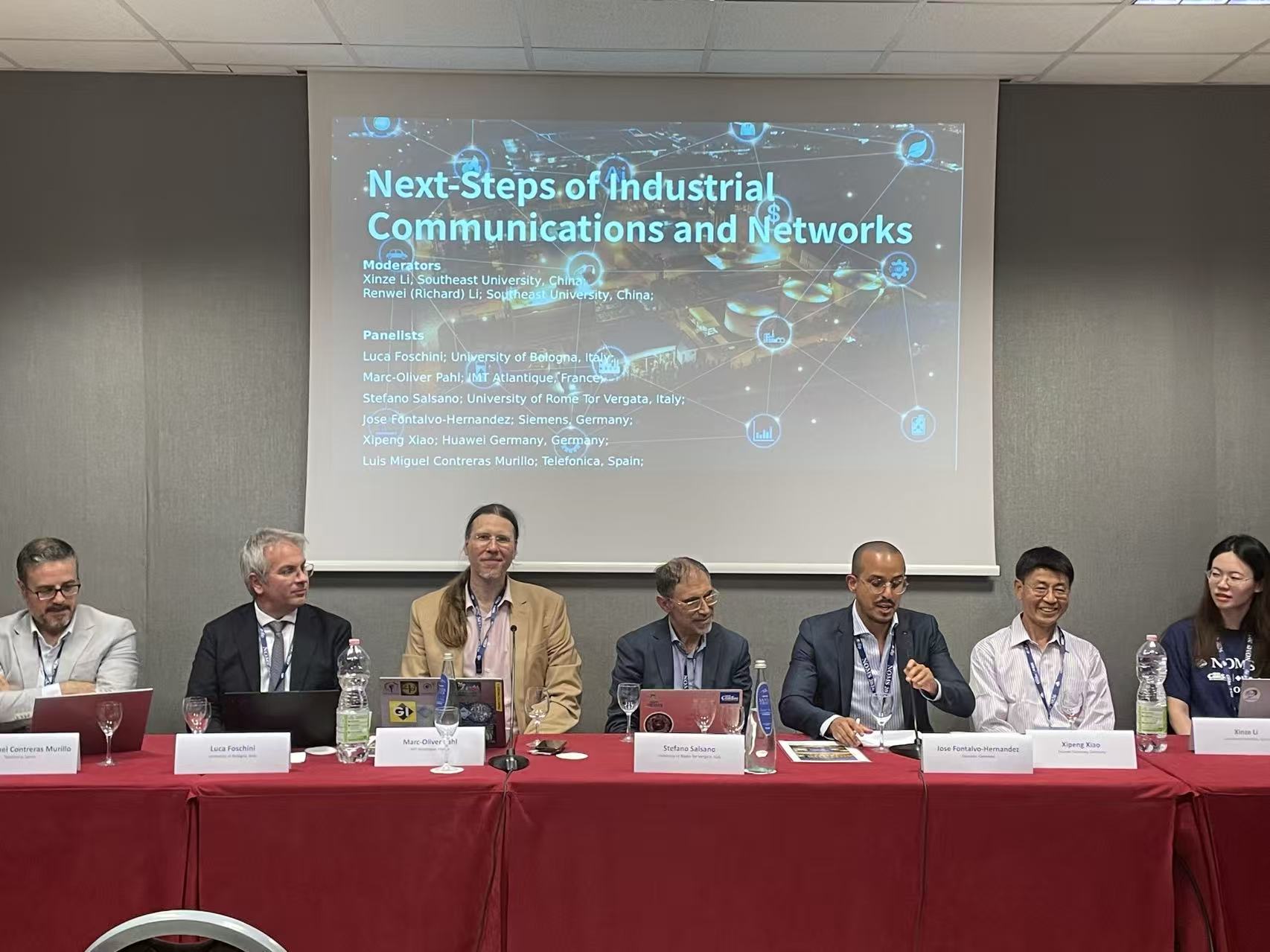
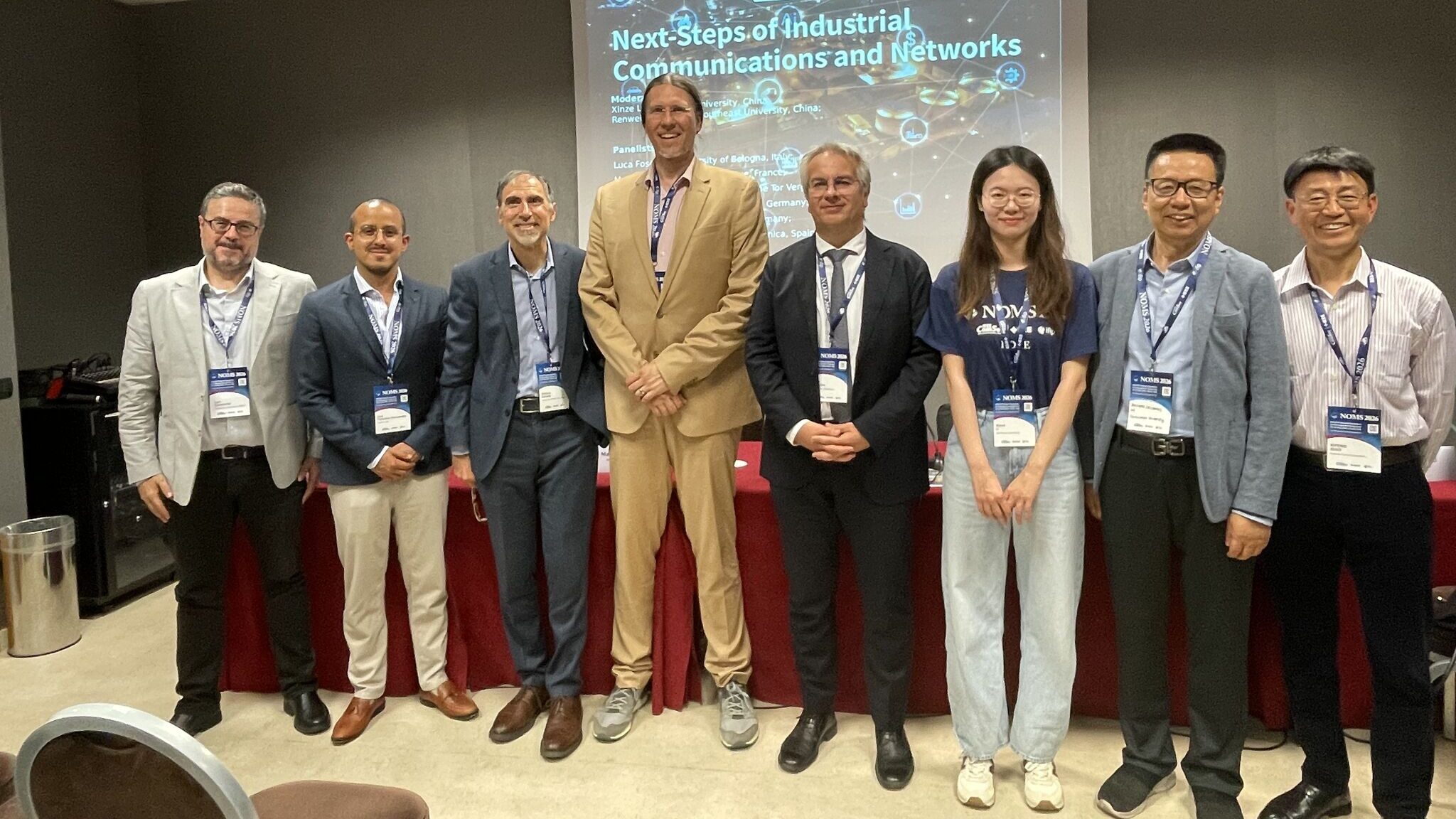
At IEEE/IFIP Network Operations and Management Symposium 2026, the panel “Next Steps of Industrial Communications and Networks” brought together researchers and industrial experts to discuss the future of industrial networking in an era increasingly shaped by AI, cloud-edge continuums, distributed automation, and cyber-physical convergence.
The panel was moderated by Xinze Li (Southeast University, China) and Renwei “Richard” Li (Southeast University, China). It featured:
- Luca Foschini (University of Bologna, Italy)
- Marc-Oliver Pahl (IMT Atlantique, France)
- Stefano Salsano (University of Rome Tor Vergata, Italy)
- Jose Fontalvo-Hernandez (Siemens AG, Germany)
- Xipeng Xiao (Huawei Germany, Germany)
- Luis Miguel Contreras Murillo (Telefónica, Spain)
Representing the Cyber CNI Chair at IMT Atlantique, Chairholder Marc-Oliver Pahl contributed perspectives on resilience, trustworthy autonomy, AI-driven operations, and cybersecurity challenges emerging from the convergence of industrial systems and modern IT infrastructures.
From Connectivity to Trustworthy Autonomy
One of the central themes of the discussion was that industrial networking is undergoing a fundamental transformation.
Historically, industrial networks were mostly isolated, deterministic, and relatively static systems optimized for highly specific operational environments. Today, however, industrial systems are increasingly becoming:
- interconnected,
- software-defined,
- cloud-edge integrated,
- AI-assisted,
- remotely orchestrated,
- and highly dynamic.
This evolution fundamentally changes the nature of industrial communication systems.
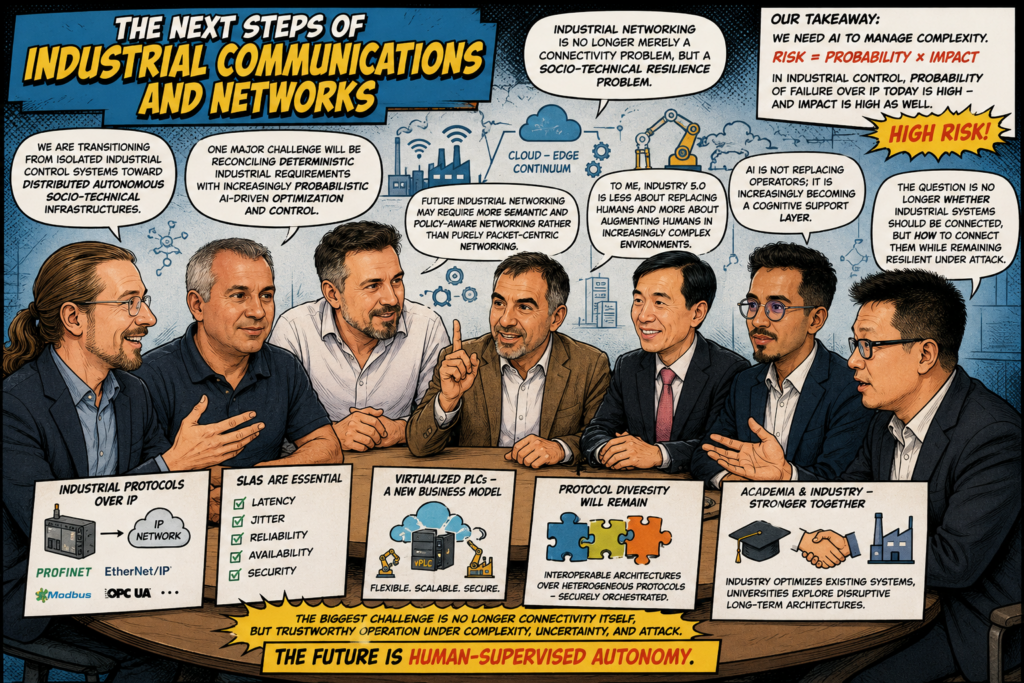
As emphasized during the panel, industrial networking is no longer merely a connectivity problem, but increasingly a socio-technical resilience problem.
The convergence of:
- industrial control systems,
- AI,
- cloud-native infrastructures,
- distributed edge computing,
- wireless communication,
- and autonomous operations
creates entirely new scientific and engineering challenges.
The question is no longer simply how to transport packets deterministically. Instead, the challenge becomes how to guarantee trustworthy autonomous operation under uncertainty, complexity, and attack.
For cybersecurity research, this is highly significant:
future industrial infrastructures will not only need to remain operational despite failures and attacks, but must also remain explainable, governable, and resilient while increasingly relying on AI-driven decision-making and distributed orchestration.
Industrial Protocols over IP and the Return of SLAs
A major topic of the panel was the ongoing transition of industrial protocols toward Layer-3/IP-based infrastructures.
Technologies such as routed PROFINET, TSN over routed environments, cloud-edge orchestration, and industrial wireless networking are increasingly moving industrial communication away from isolated Layer-2 domains toward converged IP infrastructures.
This transition enables:
- large-scale distributed industrial systems,
- cross-site industrial orchestration,
- edge-cloud continuums,
- and flexible deployment models such as virtualized PLCs.
However, this architectural evolution also introduces new risks and scientific challenges.
Industrial systems historically relied on physical isolation and highly controlled communication environments. IP-based infrastructures, by contrast, are probabilistic by nature:
they involve queuing, congestion, shared resources, dynamic routing, and multi-tenant communication patterns.
The panel therefore repeatedly returned to the importance of strict Service Level Agreements (SLAs) for:
- latency,
- jitter,
- reliability,
- availability,
- resilience,
- and security.
For cybersecurity, this raises critical research questions:
Can we guarantee resilience and safety on infrastructures originally designed for best-effort communication?
How can we monitor, verify, and enforce SLAs in adversarial environments?
How do we ensure trustworthy operation when industrial communication increasingly depends on shared cloud and IP infrastructures?
One important observation raised during the panel was that industrial networking may finally provide the real-world motivation for networking concepts that historically saw only limited adoption in enterprise networking:
QoS enforcement, semantic routing, policy-aware networking, programmable infrastructures, and cross-layer orchestration.
AI as a Complexity Management Layer
Another major topic was the role of AI in future industrial infrastructures.
Interestingly, the discussion moved beyond the common “AI for industrial automation” narrative. Instead, the panel focused strongly on AI as a mechanism for managing the operational complexity of converged infrastructures.
The increasing integration of:
- IT,
- OT,
- edge computing,
- wireless networking,
- distributed cloud infrastructures,
- and heterogeneous industrial protocols
creates operational environments whose complexity may exceed what humans can manage manually.
One important conclusion discussed during the panel was therefore:
AI may become less optional optimization and more operational necessity.
However, this immediately introduces further cybersecurity and trust challenges.
AI systems themselves are probabilistic and adaptive.
Industrial systems, in contrast, traditionally require deterministic and certifiable behavior.
Reconciling these fundamentally different paradigms represents one of the major scientific challenges for the next decade.
As emphasized during the panel:
the future is likely not fully autonomous industrial operation, but rather human-supervised autonomy.
In this vision, AI increasingly becomes:
- a cognitive support layer,
- an orchestration assistant,
- a predictive monitoring system,
- and a resilience management mechanism,
while humans remain responsible for governance, oversight, accountability, and safety-critical decisions.
This perspective directly aligns with ongoing Cyber CNI Chair research on:
- trustworthy AI operations,
- explainable cyber-defense,
- resilient distributed systems,
- anomaly detection in cyber-physical infrastructures,
- and secure autonomous operations.
Risk in Industrial Infrastructures: Probability × Impact
A particularly relevant cybersecurity perspective discussed during the panel concerned risk evaluation in industrial environments.
As stated during the discussion:
Risk = Probability × Impact
In industrial control environments:
- the probability of failures or attacks on industrial protocols operating over IP infrastructures is non-negligible,
- while the impact can be extremely high due to safety, operational, financial, or societal consequences.
This fundamentally distinguishes industrial networking from traditional enterprise IT environments.
Industrial failures may impact:
- production systems,
- energy infrastructures,
- transportation systems,
- healthcare operations,
- or critical societal services.
As a consequence, cybersecurity for industrial systems cannot be treated purely as an IT security problem.
It must instead be approached as a resilience engineering problem integrating:
- networking,
- distributed systems,
- safety engineering,
- AI,
- operations,
- and cyber-defense.
Virtualized PLCs and the Cloudification of Industrial Systems
The panel also discussed virtualized PLCs as an emerging industrial business model.
This trend reflects the broader cloudification and softwarization of industrial infrastructures:
functions previously tied to dedicated hardware are increasingly becoming deployable software services running on shared infrastructures.
While this enables:
- flexibility,
- scalability,
- orchestration,
- resource consolidation,
- and faster deployment cycles,
it also introduces new attack surfaces and trust dependencies.
For cybersecurity research, this creates highly relevant challenges around:
- secure orchestration,
- isolation,
- trust management,
- supply-chain security,
- distributed identity,
- and resilient edge-cloud infrastructures.
Why This Matters for Cybersecurity Research
For the Cyber CNI Chair, the panel strongly confirmed that the future of industrial cybersecurity lies at the intersection of:
- networking,
- AI,
- cloud-edge systems,
- distributed autonomy,
- and cyber-physical resilience.
Industrial infrastructures are evolving into autonomous socio-technical systems where communication, computation, orchestration, AI, and physical processes are deeply intertwined.
The scientific challenge is therefore no longer only protecting networks.
It is ensuring trustworthy operation under complexity, uncertainty, failures, and adversarial conditions.
This makes industrial networking one of the most important and exciting research domains for cybersecurity in the coming decade.
Panel Organizers and Moderators
Xinze Li
Research Associate and PhD Researcher — Southeast University, China
Expertise:
- 5G/6G transport networks
- Industrial networking
- Next-generation QoS
- Lossless communications
- Big Packet Protocol (BPP)
- Future advanced networking architectures
Renwei Li
Chair Professor and Director of FanLab — Southeast University, China
Former Chief Scientist and SVP at Futurewei / Huawei R&D USA
Expertise:
- Future Internet architectures
- Industrial networks
- Routing, MPLS, and transport networks
- 5G/6G networking
- Computing networks
- AI and networking
- Network protocols and architectures
- Data center and cloud networking
Panelists
Luca Foschini
Full Professor — University of Bologna, Italy
Expertise:
- Distributed and mobile systems
- Cloud-edge continuums
- Service management
- Network softwarization
- AI-enabled distributed infrastructures
- Industrial and mobile networking
- Future communication architectures
Marc-Oliver Pahl
Full Professor for Cybersecurity and Chairholder of the Cyber CNI Chair — IMT Atlantique, France
Expertise:
- Cybersecurity for critical infrastructures
- Secure cloud-edge continuums
- Industrial cybersecurity
- AI-driven network and systems management
- Federated learning
- Cyber-physical anomaly detection
- Distributed microservice architectures
- Trustworthy autonomous systems
- IT/OT convergence and resilient industrial infrastructures
Stefano Salsano
Full Professor — University of Rome Tor Vergata, Italy
Expertise:
- Networking for AI
- Software Defined Networking (SDN)
- Network Function Virtualization (NFV)
- SRv6
- Open-source networking systems
- Network softwarization
- Cybersecurity
- Future Internet architectures
Jose Fontalvo-Hernandez
Research Associate — Siemens AG, Germany
Doctoral Researcher — Chemnitz University of Technology
Expertise:
- Converged industrial networks
- 5G-TSN and DetNet integration
- Industrial networking
- Network planning
- Techno-economic analysis
- Industrial IoT
- Cloud engineering
- Robotics and automation
- Industrial communication standardization
Xipeng Xiao
Head of European Datacom SID — Huawei Germany
Expertise:
- MPLS and IP networking
- IPv6 operations
- Carrier-grade networking
- Datacom architectures
- Telecom operator infrastructures
- Scalable IP networks
- Routing technologies
- Future telecom architectures
- Network operations and deployment
Luis Miguel Contreras Murillo
Network and Cloud Architect — Telefónica, Spain
Expertise:
- Scalable telecom networks
- Cloud-network integration
- Distributed services
- Telematics
- Network planning
- Telecom architectures
- Standardization (IETF, ETSI, O-RAN)
- Cloud-native networking
- Edge-cloud infrastructures

Marc-Oliver is an adjunct professor of Carleton University in Canada. Marc-Oliver’s research focus is on a holistic approach to cybersecurity. He is an experienced teacher and an eLearning pioneer, holding several teaching awards.
Marc-Oliver holds a Diploma from University of Tübingen and a PhD from Technical University of Munich.
Marc-Oliver is Vice President of the German Chapter of the Association for Computing Machinery (ACM) (https://germany.acm.org/). He heads the Future Education activities of the German-French Academy for the Industry of the Future (https://future-industry.org/).
Marc-Oliver’s research focus is on a holistic approach to cybersecurity. He works on security-by-design, anomaly detection, human-in-the-loop, and automation. His goal is making cybersecurity manageable, resulting in highly resilient and reliable systems. Marc-Oliver publishes regularly in the network and service management and security communities.
- European Innovation Ecosystems: Lessons from Ten Years of the German-French Academy for the Industry of the Future - July 7, 2026
- France’s Cybersecurity Chairs Unite at the École Militaire: Strengthening a National Ecosystem for Cybersecurity Research - June 25, 2026
- Critical Infrastructure Cyber Resilience at Eurosatory 2026: Strengthening France’s and Europe’s Cyber Defence Ecosystem - June 24, 2026