Chaire Cyber CNI

Chaire Cyber CNI – Cybersecurity for Critical Networked Infrastructures

Critical Infrastructure Cyber Resilience at Eurosatory 2026: Strengthening France’s and Europe’s Cyber Defence Ecosystem

Protecting critical infrastructures requires close collaboration between academia, industry, and defence. Eurosatory 2026 once again demonstrated how strong this ecosystem has become.

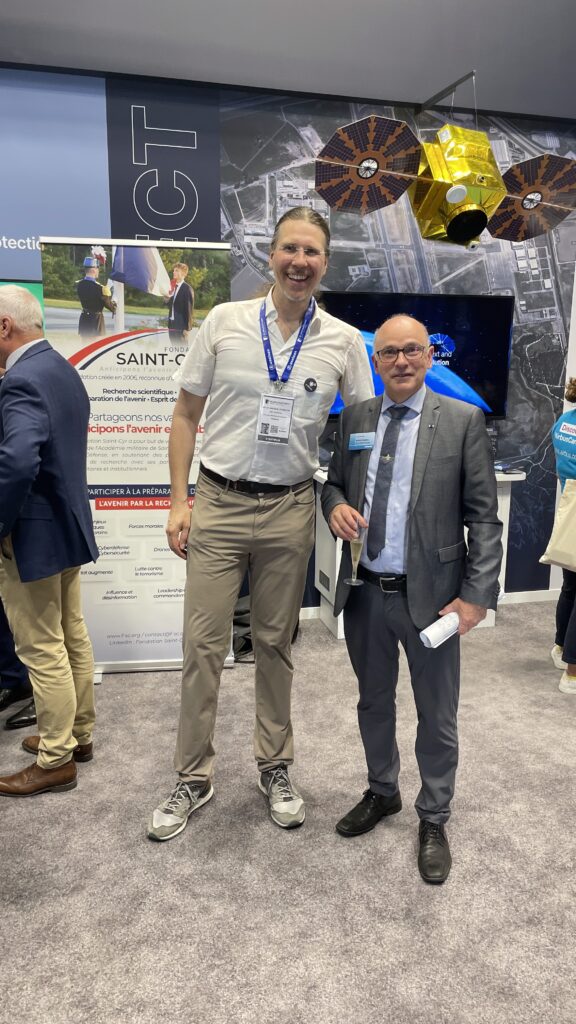
As holder of the **Cybersecurity of Critical Infrastructures (Cyber CNI) Chair** at **IMT Atlantique**, I had the pleasure of representing the Chair at **Eurosatory 2026**, exchanging with long-standing partners and colleagues committed to strengthening France’s and Europe’s cyber resilience.

A particular pleasure was meeting **General (2S) Norbert Chassang**, President of the Cyber CNI Chair and Cyber Defence Advisor at **Airbus Defence and Space**, to discuss the evolving cyber threat landscape and the strategic role of research in protecting critical infrastructures.

I also enjoyed catching up with **Nicolas Razy**, Head of Cyber Programmes at **Airbus**, and **Aurélie Laize**, Head of the **Airbus Defence and Space Cyber** site in Rennes. Both have been strong supporters of the Cyber CNI Chair for many years and continue to contribute actively to its industrial ecosystem.

Another highlight was discussing with **Nicolas Belloir** from the **Académie militaire de Saint-Cyr Coëtquidan** following the launch of the new **Airbus–Saint-Cyr Chair on Lutte Informatique d’Influence**. It is encouraging to see France strengthening its academic and industrial capabilities across complementary areas of cyber defence, resilience, and information operations.

Events like Eurosatory are essential to ensure that research remains closely aligned with operational needs. They also reinforce the partnerships that make initiatives such as **CyberSecDome** and the **Cyber CNI Chair** possible.

Many thanks to everyone for the inspiring discussions. I look forward to continuing our collaboration in support of the cybersecurity and resilience of France’s and Europe’s critical infrastructures.

#CyberCNI #Eurosatory2026 #Cybersecurity #CyberResilience #CriticalInfrastructures #CyberDefence #IMTAtlantique #Airbus #AirbusDefenceAndSpace #CyberSecDome #NationalSecurity #OperationalTechnology #DigitalSovereignty #EuropeanCybersecurity #Research #Innovation #France #Defence #CyberInnovation

Cybersecurity of Critical Infrastructures at VivaTech 2026: From Research Innovation to European Cyber Resilience

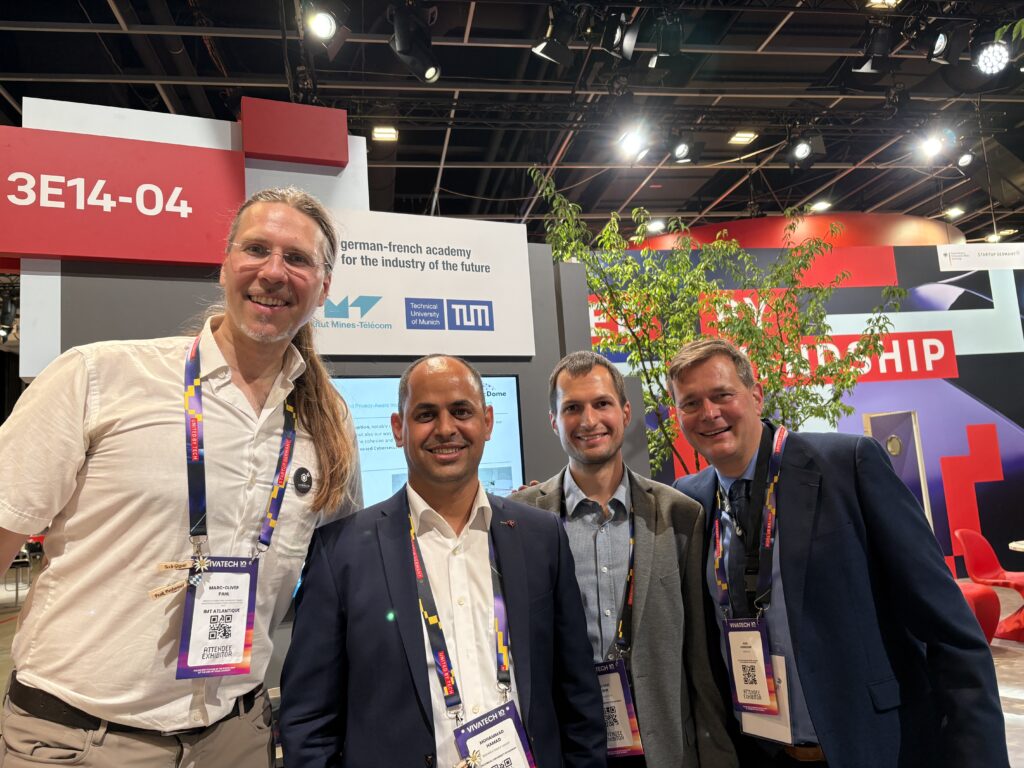
This week at VivaTech 2026 in Paris, I had the pleasure of representing the German-French Academy for the Industry of the Future (GFA) as a member of its Steering Committee.

Hosted in the German Space under the leadership of Paul-Guilhem Meunier (Institut Mines-Télécom) and Axel Honsdorf (Bayerisch-Französisches Hochschulzentrum), we showcased how Franco-German collaboration can drive research, innovation, lifelong learning, and entrepreneurship.

Together with Mohammed Hamad and Michael Kühr, I presented research initiatives from IMT Atlantique and our partners, including:

🔹 TRUE-VIEW – making invisible digital interactions visible through Extended Reality to improve trust, explainability, and cyber resilience.

🔹 DTACK – creating Digital Twins of Cyberattacks for autonomous vehicles, connected mobility, and intelligent transportation systems.

🔹 CyberSecDome – a major European initiative bringing together Airbus, IMT Atlantique, and leading partners across Europe to strengthen the cybersecurity of critical infrastructures.

On the education side, I also presented:

🎓 Future-IoT, the flagship Franco-German doctoral school co-organized with Sebastian Steinhorst (Technical University of Munich), and

🎓 Cybersecurity Essentials: From Risk to Resilience, a MOOC developed within the GFA framework to strengthen cyber skills for SMEs and non-specialists.

The week enabled many inspiring exchanges with colleagues and friends from Institut Mines-Télécom, Technical University of Munich, DFH-UFA, Airbus, Fraunhofer, DFKI, Karlsruhe Institute of Technology, the German Cyber Agency, startups, and innovation actors from both countries.

We were also honoured by visits from François Delattre, Markus Blume, Jürgen Barke, Philippe Gréciano, Andrea von Hülsen-Esch, Virginie Jouhaud-Neutard, Laurence Le Coq, and Juliane Winkelmann.

A strong reminder that cybersecurity, digital sovereignty, innovation, education, and European cooperation are becoming inseparable pillars of our digital future.

#Cybersecurity #CyberResilience #CyberSecDome #CriticalInfrastructures #VivaTech #IMTAtlantique #Airbus #FutureIoT #DigitalTwins #ExtendedReality #DigitalSovereignty #EuropeanResearch #FrancoGermanCooperation

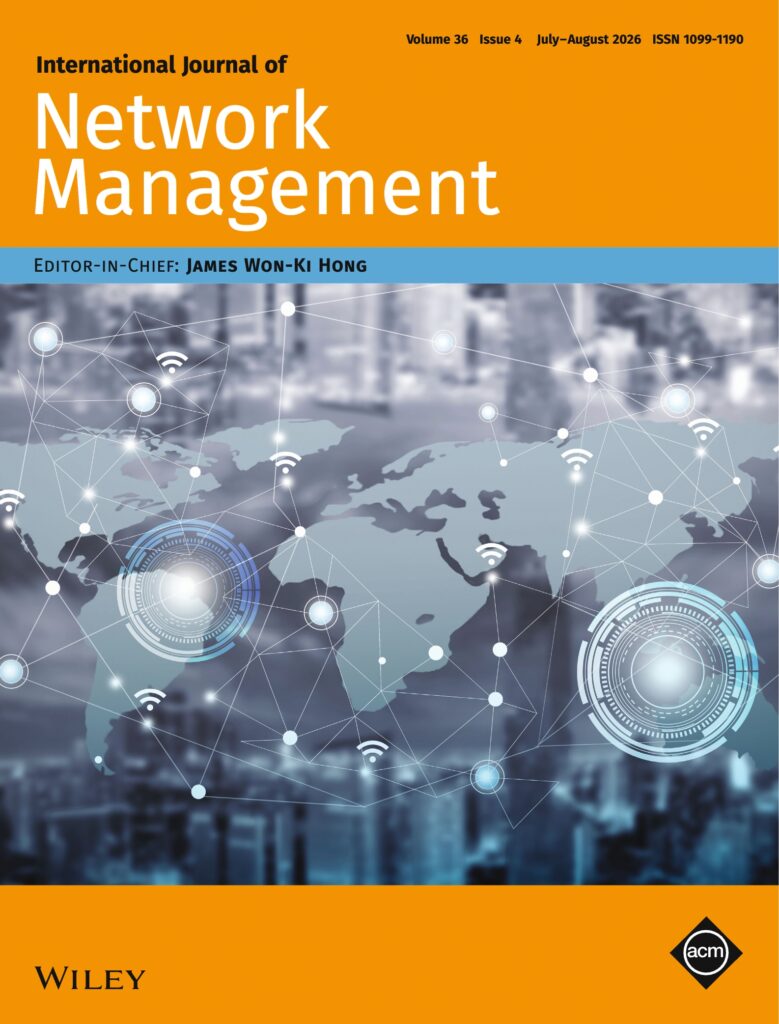
AI-driven Management and MLOps for Networks and Services: Call for Papers for a Special Issue in the International Journal of Network Management

📢 **Call for Papers: Special Issue on AI-driven Management and MLOps for Networks and Services**

🚀 New: Accepted papers are published online immediately after acceptance through Wiley’s continuous publication model, ensuring rapid visibility and impact.

Artificial Intelligence is rapidly becoming the operational core of modern communication systems. From cloud-native infrastructures and edge computing to 6G, IoT, and critical infrastructures, AI is transforming how networks and services are monitored, optimized, secured, and operated.

At the same time, the growing deployment of AI introduces new challenges: How do we manage AI models in production? How do we ensure trustworthiness, explainability, security, resilience, and governance of operational AI systems?

To address these challenges, we are pleased to invite submissions to the Special Issue:

📖 **AI-driven Management and MLOps for Networks and Services**
📍 *International Journal of Network Management (Wiley)*
📅 **Submission Deadline (with CONTINUOUS PUBLISHING UNTIL9: 31 October 2026**

🔗 CFP: https://onlinelibrary.wiley.com/page/journal/10991190/homepage/call-for-papers/si-2026-000414

This Special Issue follows the successful AIMLOps 2026 Workshop at IEEE/IFIP NOMS 2026 in Rome. The quality of the papers, presentations, and discussions demonstrated that AI-driven management and the operational management of AI itself are becoming defining challenges for future communication systems.

We particularly encourage authors to submit work on:
🔹 AI-driven network and service management
🔹 AIOps, MLOps, and LLMOps
🔹 Large Language Models for operations and troubleshooting
🔹 Autonomous and zero-touch networks
🔹 AI for cloud-native, edge, 5G/6G, and IoT environments
🔹 Explainability, transparency, and trust in AI-driven operations
🔹 Security, privacy, and governance of operational AI
🔹 Monitoring, observability, and lifecycle management of AI systems
🔹 Benchmarks, datasets, and operational experiences

For authors of AIMLOps 2026 papers, this is an excellent opportunity to extend your workshop contribution into a mature archival journal publication with deeper evaluation, broader validation, and additional scientific contributions.

We look forward to receiving your submissions and advancing the future of AI-driven networks and services together.

#CallForPapers #AI #AIOps #MLOps #LLMOps #NetworkManagement #ServiceManagement #GenerativeAI #AutonomousNetworks #ZeroTouchNetworks #CloudComputing #6G #IoT #Cybersecurity #ExplainableAI #DigitalSovereignty #CriticalInfrastructures #NOMS2026 #AIMLOps #Research

AIMLOps 2026 Workshop at IEEE/IFIP NOMS 2026 a Great Success

🚀 AI is rapidly transforming from a support tool into the operational core of future communication systems — and this was exactly the focus of the 1st AIMLOps Workshop at IEEE/IFIP NOMS 2026 in Rome.

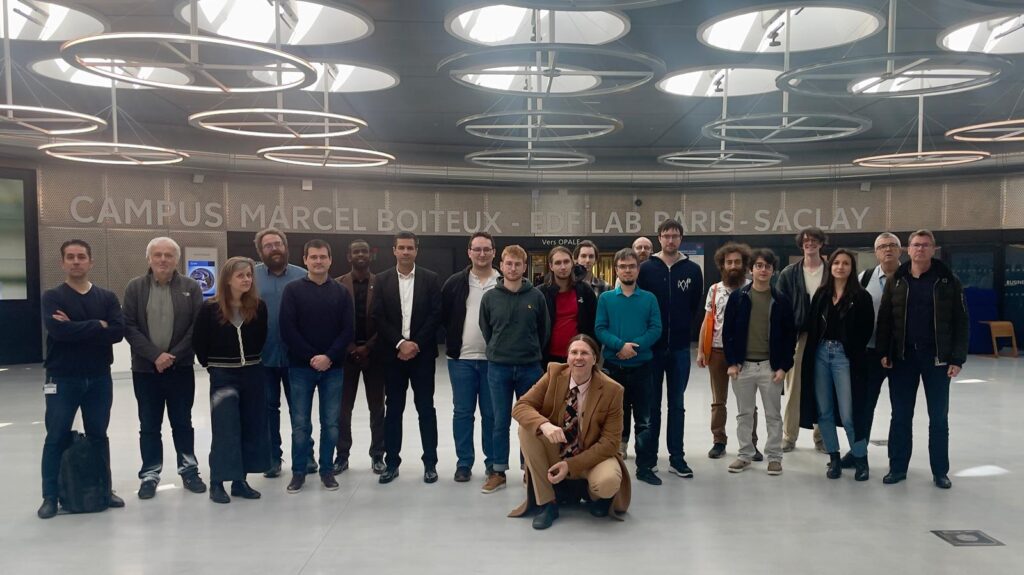
Co-organized by Marc-Oliver Pahl (IMT Atlantique / Chaire Cyber CNI), Hanan Lutfiyya (University of Waterloo), and Stuart Clayman (University College London), the workshop brought together researchers and practitioners from across Europe, North America, and Asia to discuss the future of autonomous and AI-driven network and service management.

The workshop saw strong engagement throughout the entire day:
📌 22 participants in Session 1
📌 32 participants in Session 2
📌 27 participants in Session 3
📌 25 participants in Session 4

What stood out most was the exceptional quality of the papers and the depth of the discussions. Topics ranged from:
🔹 AI-driven cybersecurity and anomaly detection
🔹 Explainable AI (XAI) for trustworthy operations
🔹 MLOps and LLMOps for AI lifecycle management
🔹 Multimodal LLMs for troubleshooting and network management
🔹 Autonomous protocol translation for IoT interoperability
🔹 AI assurance for distributed AI infrastructures
🔹 Sovereign European cloud and AI infrastructures

The Cyber CNI Chaire ecosystem was strongly represented with two research contributions addressing key challenges for future autonomous critical infrastructures.

A first contribution was presented by Mohammed Mezaouli (CNRS Lab-STICC, IMT Atlantique, Brest, France) together with Yehya Nasser, Samir Saoudi, and Marc-Oliver Pahl. Their paper, *“Closing the Loop in Embedded Security: Evolution of an AIOps Framework for Threat Hunting,”* explored how AIMLOps methodologies can secure resource-constrained embedded systems in future 6G and IoT environments through adaptive AI pipelines, side-channel telemetry analysis, continuous model adaptation, and zero-day vulnerability detection. The work demonstrated how AI lifecycle management can become a core building block for embedded cybersecurity operations.

A second Chaire-related contribution was presented by Marc-Oliver Pahl together with his PhD student Christian Lübben from the Technical University of Munich. Their paper, *“Gateway-X: LLM-based Autonomous Adaptive Semantic and Syntactic Protocol Translation,”* addressed one of the central challenges of heterogeneous IoT and industrial environments: interoperability. The work proposed a fully automated AI-driven gateway architecture capable of performing both syntactic and semantic protocol translation using Large Language Models. The research explored how Generative AI can automate “semantic interoperability” between heterogeneous systems and protocols, opening new perspectives for autonomous IoT integration, intelligent gateways, and zero-touch operations in future cyber-physical infrastructures.

The keynote sessions perfectly complemented the technical program.

🎤 Deep Medhi (National Science Foundation, USA) delivered the keynote *“When Networks Think for Themselves: Who Is in-charge?”* and challenged the community to rethink trust, explainability, and control in future autonomous and zero-touch networks where AI systems increasingly make operational decisions themselves.

🎤 Hans Torben Löfflad and Manuel Hoffmann from STACKIT presented *“A European Data & AI Strategy – A Cloud Provider’s View.”* Their keynote addressed sovereign European cloud infrastructures, large-scale AI model serving, Kubernetes-based AI platforms, and Europe’s path toward digital sovereignty.

This discussion was particularly timely as STACKIT was recently selected by the European Commission as one of the providers for the EU Sovereign Cloud procurement initiative — a major milestone for resilient and sovereign European digital infrastructures and highly relevant for research on cyber-secure critical infrastructures.

A huge thank you to all authors, keynote speakers, participants, and organizers for making AIMLOps 2026 such an engaging and inspiring event. The workshop clearly demonstrated that AI lifecycle management, operational trustworthiness, resilience, sovereignty, and interoperability are becoming defining challenges for the future of networking and distributed systems.

#AIMLOps #NOMS2026 #AI #AIOps #MLOps #LLMOps #AutonomousNetworks #Cybersecurity #DigitalSovereignty #SovereignCloud #6G #IoT #NetworkManagement #GenerativeAI #CloudComputing #Interoperability #CyberCNI
View More