Chaire Cyber CNI

Chaire Cyber CNI – Cybersecurity for Critical Networked Infrastructures

European Innovation Ecosystems: Lessons from Ten Years of the German-French Academy for the Industry of the Future

🇪🇺 Sometimes a birthday cake tells a bigger story than a hundred project reports.

When we cut the birthday cake at Viva Technology 2026 to celebrate the 10th anniversary of the German-French Academy for the Industry of the Future (GFA), I suddenly realized something.

We were not celebrating ten years of an institution.

We were celebrating ten years of relationships.

Researchers greeting collaborators they had not seen for years.

Students introducing mentors from another country.

Industrial partners already discussing the next joint project.

Friends meeting again.

Looking back over almost a decade, I realized that the Academy’s greatest achievement was never a single research project, a doctoral school or an innovation event.

It was creating a community.

That reflection led me to write something I had wanted to write for quite some time.

Not a birthday message.

Not a project report.

But an essay about something I have gradually come to regard as one of Europe’s most important strategic capabilities:

How do we build international innovation ecosystems?

Over the past ten years, I have had the privilege of helping shape this journey through collaborative research projects, educational initiatives such as Future-IoT, lifelong learning, strategy development and the Steering Committee of the Academy.

Along the way I discovered something that surprised even me.

Many of the most successful collaborations started with nothing more than a short conversation.

Projects ended.

Communities continued.

The article is my attempt to distill what ten years of Franco-German collaboration have taught me—not only about research and education, but about trust, ecosystem building and Europe’s future.

Among the ideas that stayed with me most are:

🔹 Research projects do not create ecosystems. People do.

🔹 Relationships deserve institutions.

🔹 Communities are Europe’s most valuable innovation infrastructure.

Thank you to everyone who helped build this remarkable community over the past decade—especially Paul-Guilhem Meunier, whose ability to cultivate ecosystems rather than merely manage projects has inspired me throughout these years, and to the many wonderful colleagues from IMT, TUM, DFH/UFA, industry and public institutions who made this journey possible.

I hope you enjoy reading it.

👉 Continue reading…

🇪🇺❤️🇫🇷🤝🇩🇪

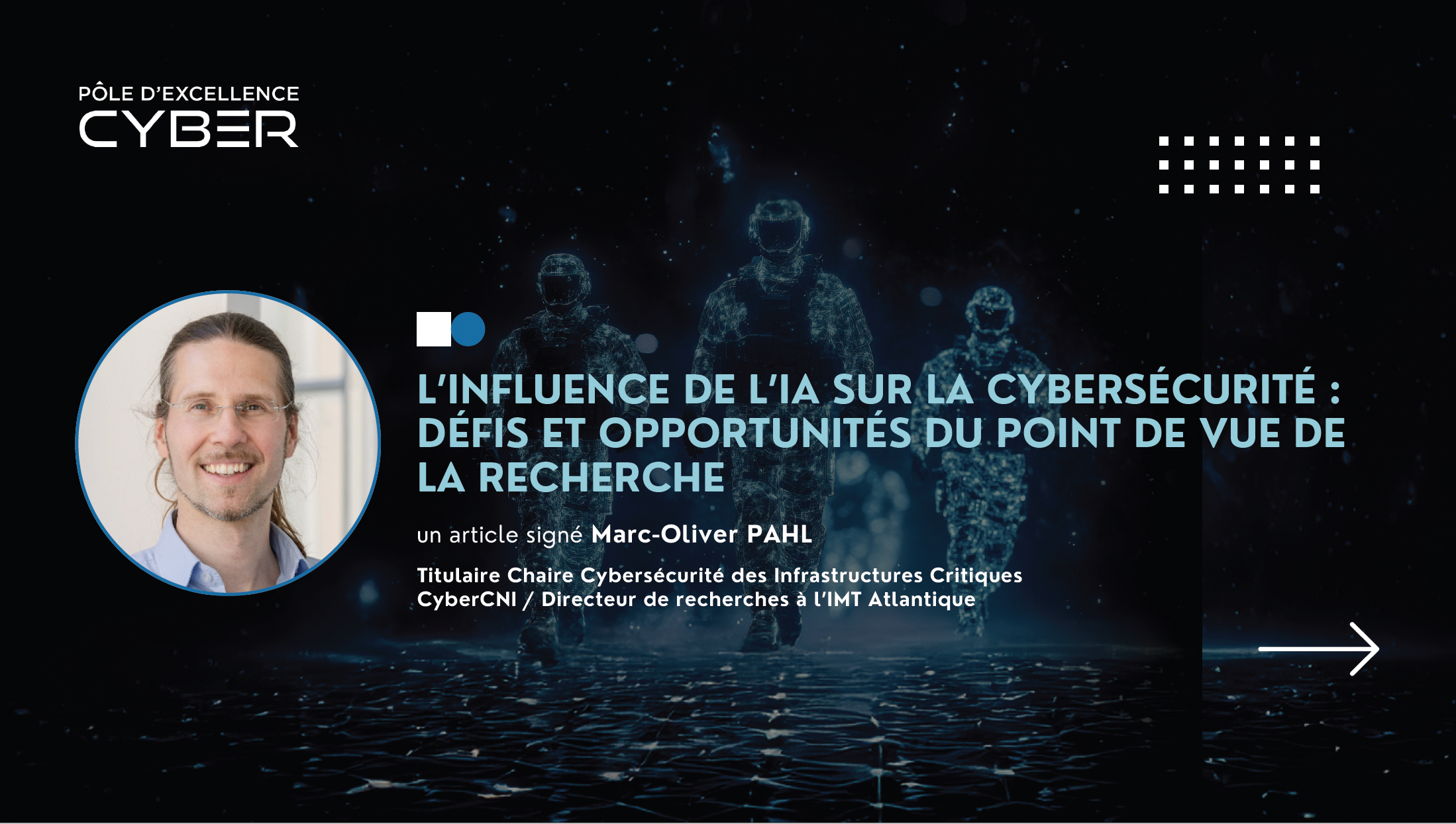
AI : Prof. Marc-Oliver Pahl writes a powerful article on the challenges of AI

In an article published in the 10th issue of the Gesellschaft für Informatik’s .Inf magazine, Professor Marc-Oliver Pahl, holder of the Cyber CNI Chair at IMT Atlantique, warns of the upheavals caused by generative artificial intelligence. Between the creation of hyper-realistic content, extreme personalization of information and new forms of cyber-attack, he calls for a strengthening of mediacompetence and an urgent social debate on the uses of AI

Open Standards and Open Education as Motor for Innovation

Open Standards and Open Education play a central role not only for interoperability but also for cybersecurity! They allow different stakeholders to efficiently meet a certain level of service – the open standard. A good example from the automobile industry is the three-point seatbelt. Our chairholder, Marc-Oliver Pahl, had the pleasure to work with Max Senges (42 Wolfsburg) and Vint Cerf (Chief Internet Evangelist at Google) on a manifesto for more Open Standards and Open Education in the automobile industry.

The full article and its discussion can be found here: https://www.linkedin.com/pulse/its-time-team-up-develop-open-standards-education-emergent-max-senges/

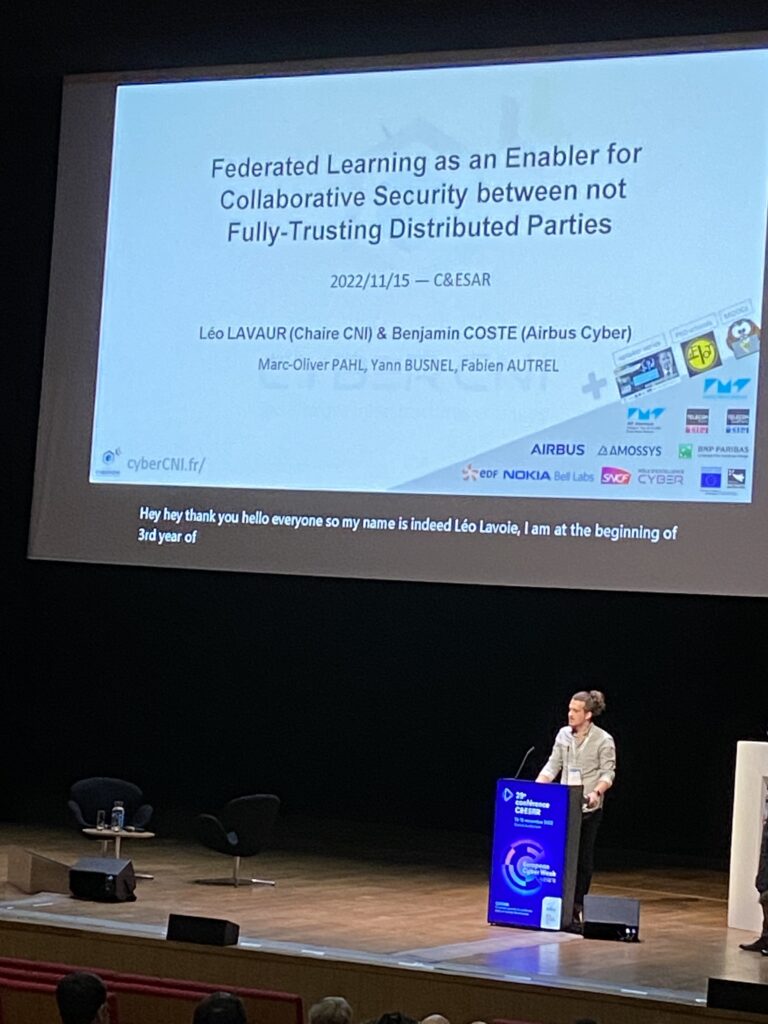
Federated Learning as enabler for Collaborative Security between not Fully-Trusting Distributed Parties

Our PhD student Léo Lavaur (IMT Atlantique, Topic T9: Federated approaches for defending cyber-attacks) participated in the C&ESAR conferences at the ECW held from 15 to 17 November 2022 in Rennes where he presented his paper :

“Federated Learning as enabler for Collaborative Security between not Fully-Trusting Distributed Parties”
Léo Lavaur, Benjamin Costé, Marc-Oliver Pahl, Yann Busnel and Fabien Autrel

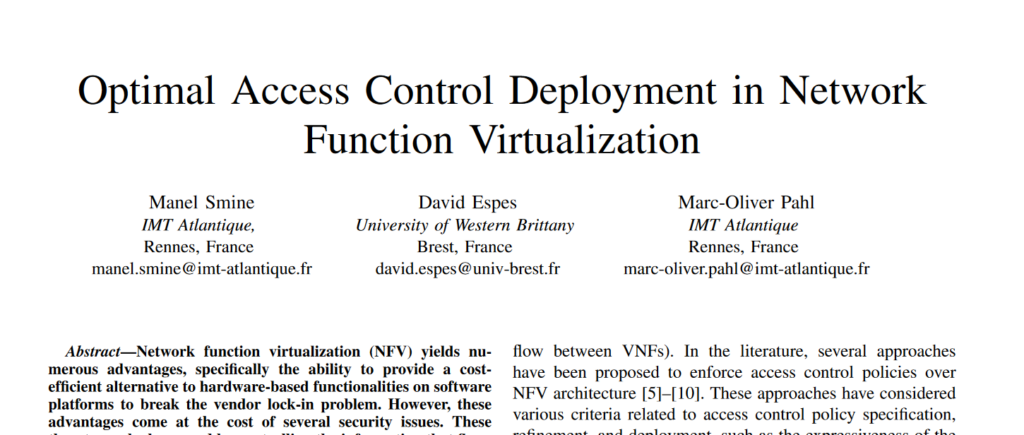
Optimal Access Control Deployment in NetworkFunction Virtualization

La Chaire CyberCNI a participé au 34e Network Operations and Management Symposium (NOMS 2022) qui s’est tenu du 25 au 29 avril 2022 à Budapest (Hongrie).
Cet événement qui a rassemblé quelques 180 participants a permis à la chaire de présenter 5 communications dont celle de Manel Smine :
NOMS 2022 – Full paper Manel Smine, David Espes, Marc-Oliver Pahl, “Optimal Access Control Deployment in Network Function Virtualization

View More