Chaire Cyber CNI

Chaire Cyber CNI – Cybersecurity for Critical Networked Infrastructures

CyberSecDome XR Cybersecurity Demo at IRISA

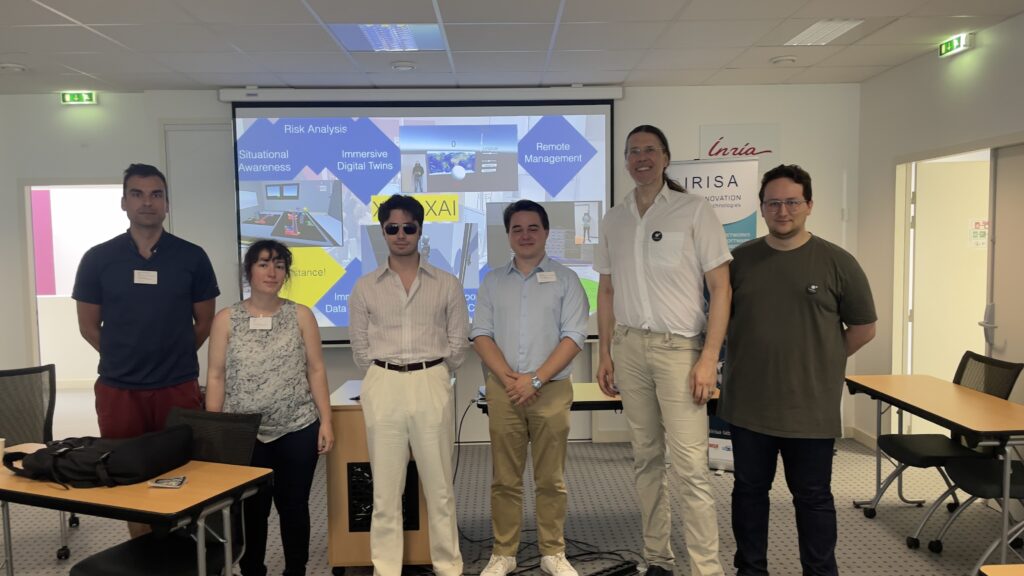
A great day yesterday presenting the European project CyberSecDome at the CNRS UMR IRISA laboratory in Rennes during the visit of the Jeunes IHEDN.

Many thanks to Olivier Barais for opening the session and highlighting the strong cybersecurity ecosystem within IRISA.

As part of the activities carried by the Chaire Cybersécurité des Infrastructures Critiques within the IRISA environment, we presented our work on next-generation cybersecurity interfaces combining AI and XR technologies to improve situational awareness and reduce the cognitive load of cyber experts facing increasingly complex infrastructures.

Marc-Oliver Pahl introduced the CyberSecDome vision, architecture, and operational context, while Fabien Eyssartier delivered an impressive live demonstration of the immersive platform.

The discussions with participants were extremely engaging, ranging from operational cybersecurity to resilience and disinformation challenges. Seeing participants directly experiment with the interfaces and discuss future applications was particularly rewarding.

CyberSecDome continues to demonstrate how Europe can combine AI, immersive technologies, and operational cybersecurity expertise to strengthen the resilience of critical infrastructures.

A real pleasure to support IRISA during this successful event — and we look forward to many future collaborations with the IHEDN community.

#CyberSecurity #CyberDefense #XR #VirtualReality #AI #CriticalInfrastructure #CyberResilience #SituationalAwareness #HorizonEurope #IRISA #IMTAtlantique #CyberSecDome

Wrapping Up an Inspiring Journey in the New Master Cybersecurity Program at IMT Atlantique

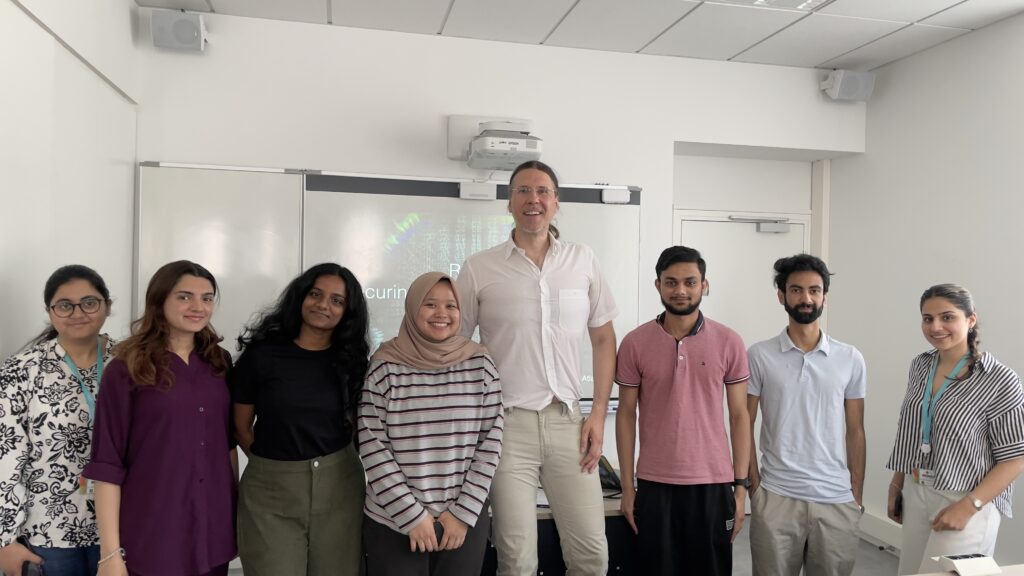
Today was the final session of my teaching engagement in the new Master Cybersecurity program at IMT Atlantique in Rennes — and what an inspiring experience it has been.

Over the past weeks, I had the pleasure of teaching a fantastic group of students in our course on *Securing Critical Infrastructures*. With 8 female and 2 male students, the class brought together strong technical backgrounds, curiosity, critical thinking, and excellent discussions throughout the course.

We explored topics such as:
🔹 OT vs IT security
🔹 Industrial Control Systems (ICS)
🔹 Attack chains and cyber resilience
🔹 Security-by-design
🔹 Monitoring and anomaly detection
🔹 Human-centered cybersecurity
🔹 QUANTUMINSERT, Snowden, and the ethics of cybersecurity

For today’s final recap session before Friday’s exam, we connected all course topics into one big picture: how modern connectivity creates both enormous opportunities and major attack surfaces for critical infrastructures.

I was also very happy to invite two colleagues working with me on current cybersecurity projects:

🔹 Axel Dupraz presented hands-on demonstrations around real-world critical infrastructure cybersecurity challenges and operational exercises.

🔹 Fabien Eyssartier, working with me on the Horizon Europe project CyberSecDome, demonstrated next-generation cybersecurity interfaces and immersive approaches for future SOC environments. This led to fascinating discussions on usability, operator support, situational awareness, and human-centered cybersecurity.

One thing became very clear once again:
Cybersecurity is not only about technology. It is also about humans, communication, decision-making, resilience, and responsibility.

A huge thank you to all students for the excellent atmosphere, the energy, and the many thoughtful discussions throughout the course. Teaching becomes truly rewarding when students actively contribute their own perspectives and experiences.

Now only the written exam on Friday remains.

Good luck to all of you — and thank you for this great experience!

#Cybersecurity #CriticalInfrastructure #ICS #OTSecurity #CyberResilience #SecurityByDesign #CyberDefense #CyberSecDome #HorizonEurope #IndustrialCybersecurity #HumanCenteredCybersecurity #IMTAtlantique #Rennes #Teaching #CyberEducation

AIMLOps 2026 Workshop at IEEE/IFIP NOMS 2026 a Great Success

🚀 AI is rapidly transforming from a support tool into the operational core of future communication systems — and this was exactly the focus of the 1st AIMLOps Workshop at IEEE/IFIP NOMS 2026 in Rome.

Co-organized by Marc-Oliver Pahl (IMT Atlantique / Chaire Cyber CNI), Hanan Lutfiyya (University of Waterloo), and Stuart Clayman (University College London), the workshop brought together researchers and practitioners from across Europe, North America, and Asia to discuss the future of autonomous and AI-driven network and service management.

The workshop saw strong engagement throughout the entire day:
📌 22 participants in Session 1
📌 32 participants in Session 2
📌 27 participants in Session 3
📌 25 participants in Session 4

What stood out most was the exceptional quality of the papers and the depth of the discussions. Topics ranged from:
🔹 AI-driven cybersecurity and anomaly detection
🔹 Explainable AI (XAI) for trustworthy operations
🔹 MLOps and LLMOps for AI lifecycle management
🔹 Multimodal LLMs for troubleshooting and network management
🔹 Autonomous protocol translation for IoT interoperability
🔹 AI assurance for distributed AI infrastructures
🔹 Sovereign European cloud and AI infrastructures

The Cyber CNI Chaire ecosystem was strongly represented with two research contributions addressing key challenges for future autonomous critical infrastructures.

A first contribution was presented by Mohammed Mezaouli (CNRS Lab-STICC, IMT Atlantique, Brest, France) together with Yehya Nasser, Samir Saoudi, and Marc-Oliver Pahl. Their paper, *“Closing the Loop in Embedded Security: Evolution of an AIOps Framework for Threat Hunting,”* explored how AIMLOps methodologies can secure resource-constrained embedded systems in future 6G and IoT environments through adaptive AI pipelines, side-channel telemetry analysis, continuous model adaptation, and zero-day vulnerability detection. The work demonstrated how AI lifecycle management can become a core building block for embedded cybersecurity operations.

A second Chaire-related contribution was presented by Marc-Oliver Pahl together with his PhD student Christian Lübben from the Technical University of Munich. Their paper, *“Gateway-X: LLM-based Autonomous Adaptive Semantic and Syntactic Protocol Translation,”* addressed one of the central challenges of heterogeneous IoT and industrial environments: interoperability. The work proposed a fully automated AI-driven gateway architecture capable of performing both syntactic and semantic protocol translation using Large Language Models. The research explored how Generative AI can automate “semantic interoperability” between heterogeneous systems and protocols, opening new perspectives for autonomous IoT integration, intelligent gateways, and zero-touch operations in future cyber-physical infrastructures.

The keynote sessions perfectly complemented the technical program.

🎤 Deep Medhi (National Science Foundation, USA) delivered the keynote *“When Networks Think for Themselves: Who Is in-charge?”* and challenged the community to rethink trust, explainability, and control in future autonomous and zero-touch networks where AI systems increasingly make operational decisions themselves.

🎤 Hans Torben Löfflad and Manuel Hoffmann from STACKIT presented *“A European Data & AI Strategy – A Cloud Provider’s View.”* Their keynote addressed sovereign European cloud infrastructures, large-scale AI model serving, Kubernetes-based AI platforms, and Europe’s path toward digital sovereignty.

This discussion was particularly timely as STACKIT was recently selected by the European Commission as one of the providers for the EU Sovereign Cloud procurement initiative — a major milestone for resilient and sovereign European digital infrastructures and highly relevant for research on cyber-secure critical infrastructures.

A huge thank you to all authors, keynote speakers, participants, and organizers for making AIMLOps 2026 such an engaging and inspiring event. The workshop clearly demonstrated that AI lifecycle management, operational trustworthiness, resilience, sovereignty, and interoperability are becoming defining challenges for the future of networking and distributed systems.

#AIMLOps #NOMS2026 #AI #AIOps #MLOps #LLMOps #AutonomousNetworks #Cybersecurity #DigitalSovereignty #SovereignCloud #6G #IoT #NetworkManagement #GenerativeAI #CloudComputing #Interoperability #CyberCNI

View More