Cybersecurity of Critical Infrastructures at VivaTech 2026: From Research Innovation to European Cyber Resilience
Cybersecurity of Critical Infrastructures was at the heart of the Cyber CNI Chair’s participation in VivaTech 2026. Through research projects such as TRUE-VIEW, DTACK, and CyberSecDome, as well as educational initiatives including Future-IoT and the Cybersecurity Essentials MOOC, the Chair showcased how research, innovation, and training contribute to a more resilient and sovereign digital future for Europe.
Cyber CNI at VivaTech 2026
VivaTech 2026 once again demonstrated Europe’s extraordinary capacity for innovation. Bringing together startups, industrial leaders, public institutions, researchers, entrepreneurs, and policy makers from around the world, the event provided a unique platform to discuss the technologies that will shape the future of our societies and economies.
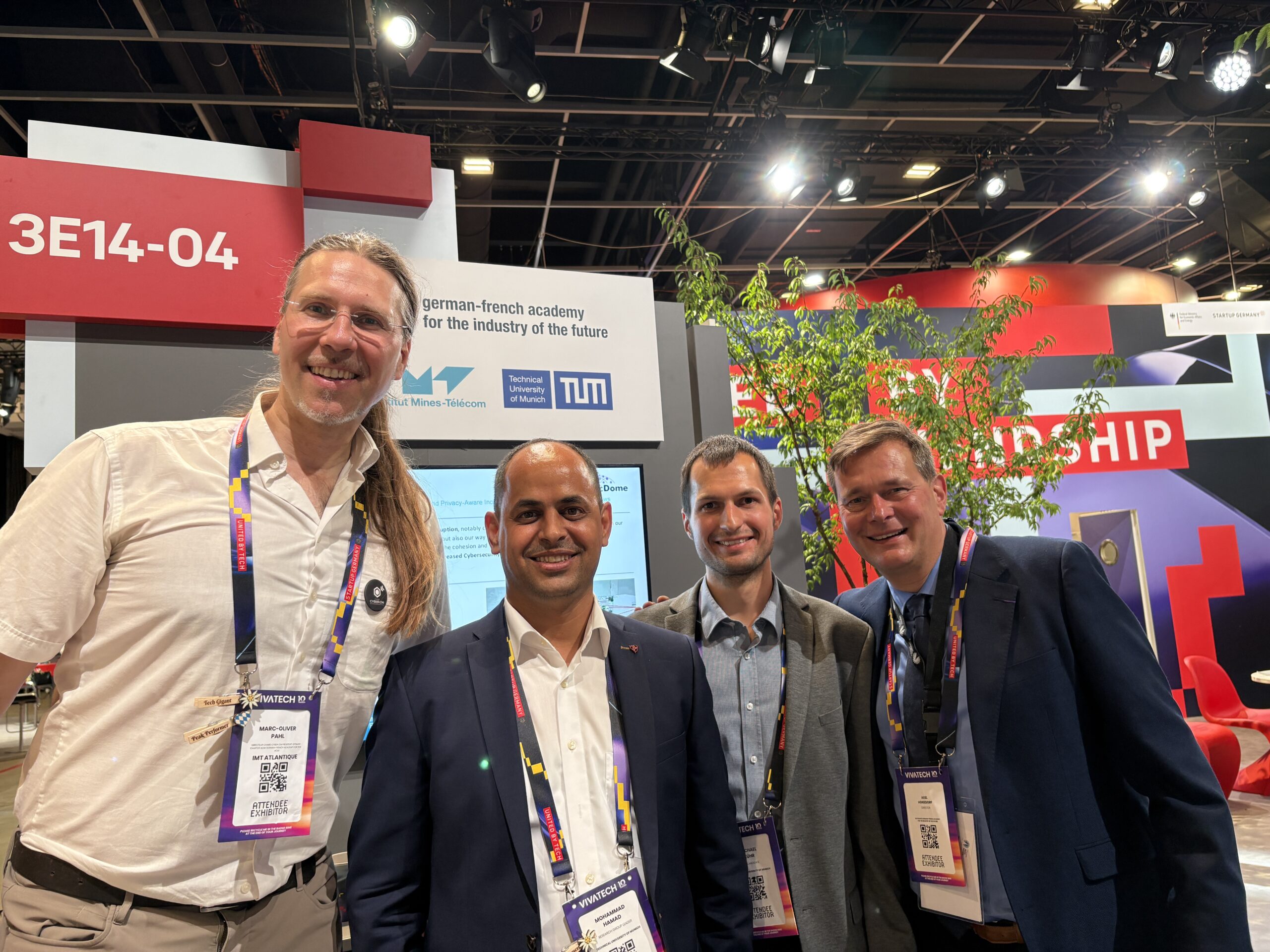
As holder of the Cybersecurity of Critical Infrastructures Chair (Cyber CNI) at IMT Atlantique, Marc-Oliver Pahl participated in VivaTech as a Steering Committee member of the German-French Academy for the Industry of the Future (GFA), a strategic initiative jointly supported by Institut Mines-Télécom (IMT) and the Bayerisch-Französisches Hochschulzentrum (BFHZ).
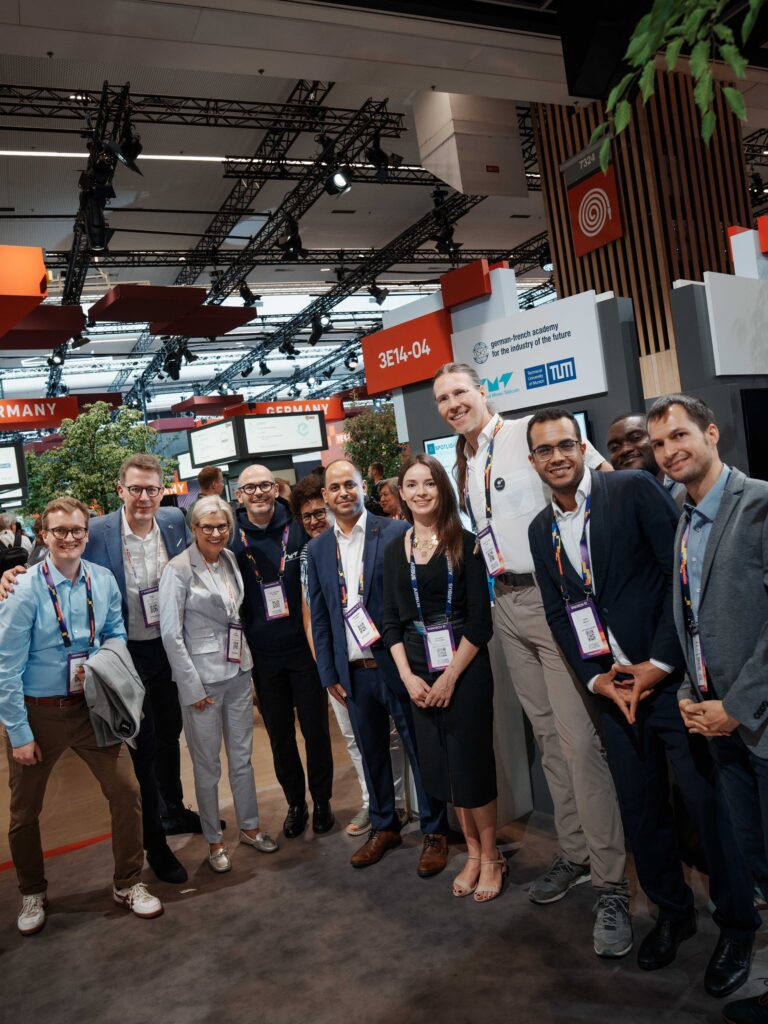
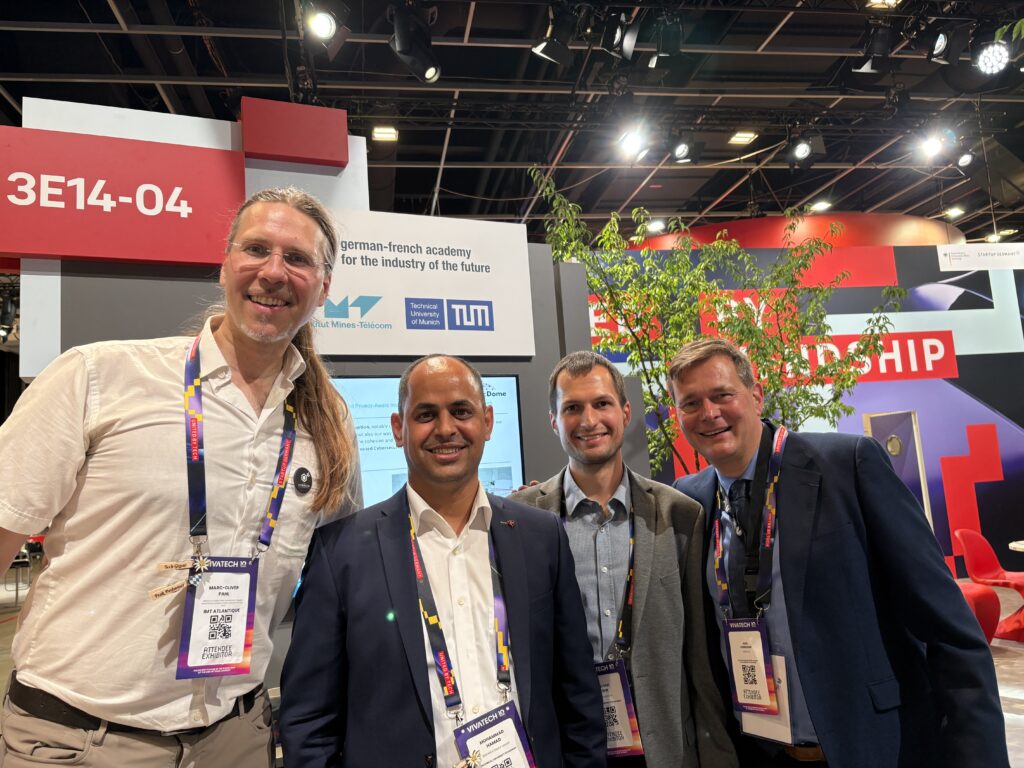
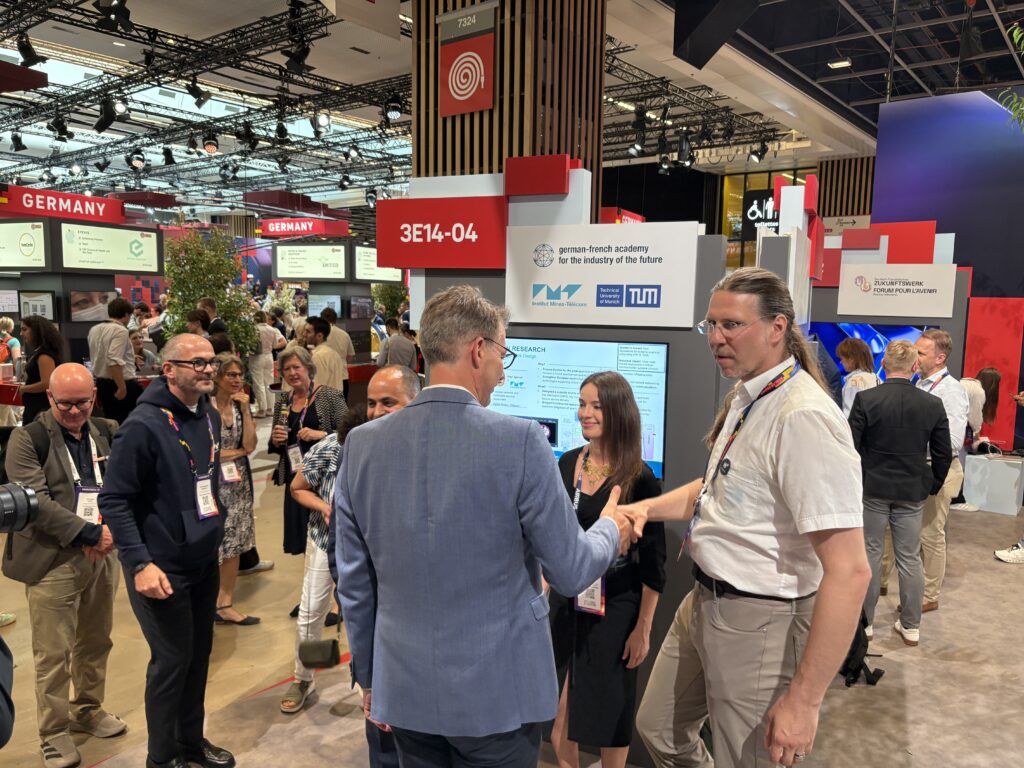
Hosted within the German Space, the GFA booth illustrated the strength of Franco-German cooperation across research, innovation, education, entrepreneurship, and technology transfer. Under the leadership of Paul-Guilhem Meunier (IMT) and Axel Honsdorf (BFHZ), the Academy continues to strengthen collaboration between France and Germany through its three strategic pillars:
- Research
- Lifelong Learning
- Startups
The Cyber CNI Chair actively contributes to the first two pillars, helping transform cybersecurity research into operational capabilities and educational initiatives that strengthen Europe’s resilience, competitiveness, and technological sovereignty.
Exchanges with Leaders of the European Innovation Ecosystem
VivaTech also offered a valuable opportunity to engage with representatives from academia, industry, innovation agencies, startups, and public institutions from across Europe.
The GFA booth was honoured by visits from several distinguished representatives of the French and German innovation ecosystems, including:
- François Delattre, Ambassador of France to Germany
- Markus Blume, Bavarian Minister of Science and Arts
- Jürgen Barke, Saarland Minister for Economy, Innovation, Digital Affairs and Energy
- Julia Schwarz, Referatsleiterin im Bayerischen Wirtschaftsministerium
- Philippe Gréciano, Vice President of the DFH/UFA
- Andrea von Hülsen-Esch, Vice President of the DFH/UFA
- Virginie Jouhaud-Neutard, Deputy Secretary General of the DFH/UFA
- Laurence Le Coq, Dean of Research and Economic Development at IMT
- Juliane Winkelmann, Senior Vice President for International Alliances and Alumni at the Technical University of Munich
The event also enabled fruitful exchanges with representatives from Airbus, Karlsruhe Institute of Technology, DFKI, the German Cyber Agency, startup founders, innovation managers, and researchers working on the future of digital technologies and cybersecurity.
These discussions highlighted the growing recognition that cybersecurity has become a foundational capability for innovation, digital transformation, and industrial competitiveness.
Cybersecurity of Critical Infrastructures in the Age of Digital Transformation
Critical infrastructures, transportation systems, industrial facilities, and public services are becoming increasingly interconnected and autonomous.
While this transformation creates enormous opportunities, it also introduces new cybersecurity challenges. Operators, engineers, and decision-makers must increasingly manage complex cyber-physical environments that continuously generate large volumes of data, interactions, and security events.
Helping humans understand, validate, and secure such environments has become a central research objective of the Cyber CNI Chair and its partners.
TRUE-VIEW: Making the Invisible Visible
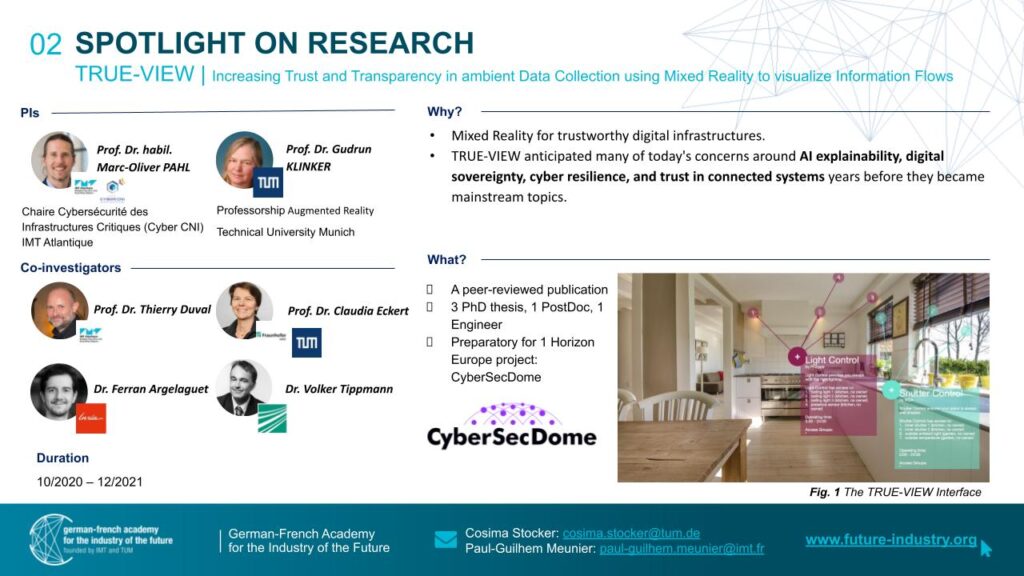
The first project presented at VivaTech was TRUE-VIEW, a French-German research initiative conducted by IMT Atlantique, the Technical University of Munich (TUM), and INRIA.
Long before explainable artificial intelligence, trustworthy AI, and digital sovereignty became mainstream topics, TRUE-VIEW explored how immersive technologies could help humans better understand increasingly complex digital systems.
Using Mixed Reality and Extended Reality technologies, the project investigated how hidden interactions between sensors, applications, devices, cloud services, and industrial systems can be visualized directly within the physical environment.
The objective was straightforward but ambitious: reducing cognitive overload, improving situational awareness, and strengthening trust in connected systems.
Today, as organizations seek better visibility into increasingly autonomous environments, many of the concepts explored by TRUE-VIEW remain highly relevant.
DTACK: Digital Twins of Cyberattacks
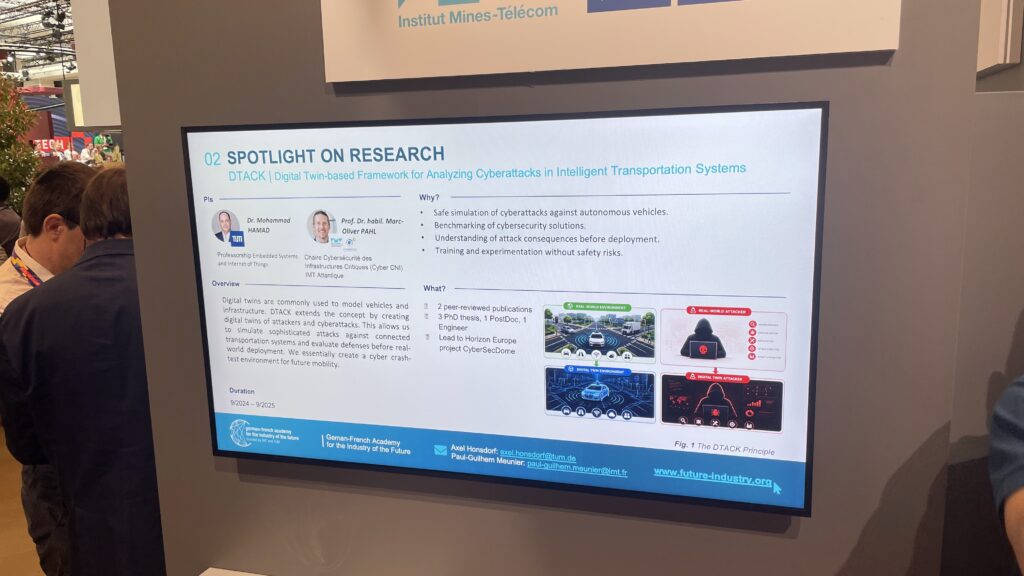
Building on the challenge of understanding complex digital systems, the DTACK project addresses another key question:
How can organizations validate cyber resilience before attacks occur?
Modern transportation systems—including connected vehicles, autonomous mobility platforms, intelligent transportation infrastructures, and smart rail systems—are becoming highly software-defined and increasingly connected.
Testing cyberattacks against such systems in real-world conditions is often costly, difficult, and potentially dangerous.
DTACK introduces Digital Twins of Cyberattacks.
Instead of waiting for real incidents, attackers, attack techniques, attack timing, and attack consequences can be reproduced inside a virtual environment. Manufacturers, operators, and researchers can safely evaluate cyber threats, validate security mechanisms, benchmark cybersecurity solutions, and improve resilience before deployment.
The project effectively creates a cybersecurity crash-test laboratory for the connected mobility systems of tomorrow.
From Research Prototypes to European Cyber Resilience
TRUE-VIEW focused on understanding complex digital environments.
DTACK focuses on validating their resilience.
The next challenge is protecting these systems at operational scale.
This is where CyberSecDome comes in.
CyberSecDome: Securing Europe’s Critical Infrastructures
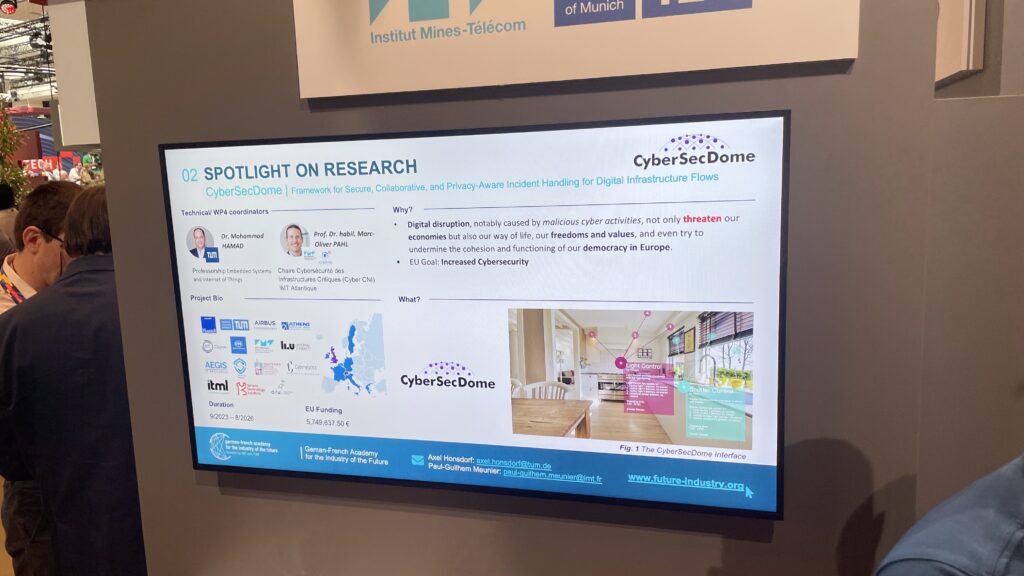
At VivaTech, the Cyber CNI Chair also presented ongoing work within CyberSecDome, a major European cybersecurity initiative bringing together leading industrial and academic partners, including Airbus, IMT Atlantique, and numerous organizations across Europe.
CyberSecDome develops innovative technologies designed to improve the protection, resilience, and operational security of critical infrastructures and strategic digital assets.
The project addresses several strategic priorities for Europe:
- Protection of critical infrastructures
- Large-scale cyber resilience
- Security operations and situational awareness
- AI-supported cybersecurity
- Digital sovereignty
- Cross-border European collaboration
Taken together, TRUE-VIEW, DTACK, and CyberSecDome illustrate a coherent long-term research vision.
First, organizations must understand increasingly complex digital environments.
Second, they must validate their resilience through realistic testing.
Finally, they must protect these systems in operational conditions.
This continuum reflects the mission of the Cyber CNI Chair: transforming research excellence into practical capabilities that strengthen the resilience of critical infrastructures.
Educating the Next Generation of Cybersecurity Leaders
Technological innovation alone is not sufficient.
Building resilient digital societies also requires developing the skills, expertise, and talent necessary to operate and secure future infrastructures.
Future-IoT: A Flagship German-French Doctoral School
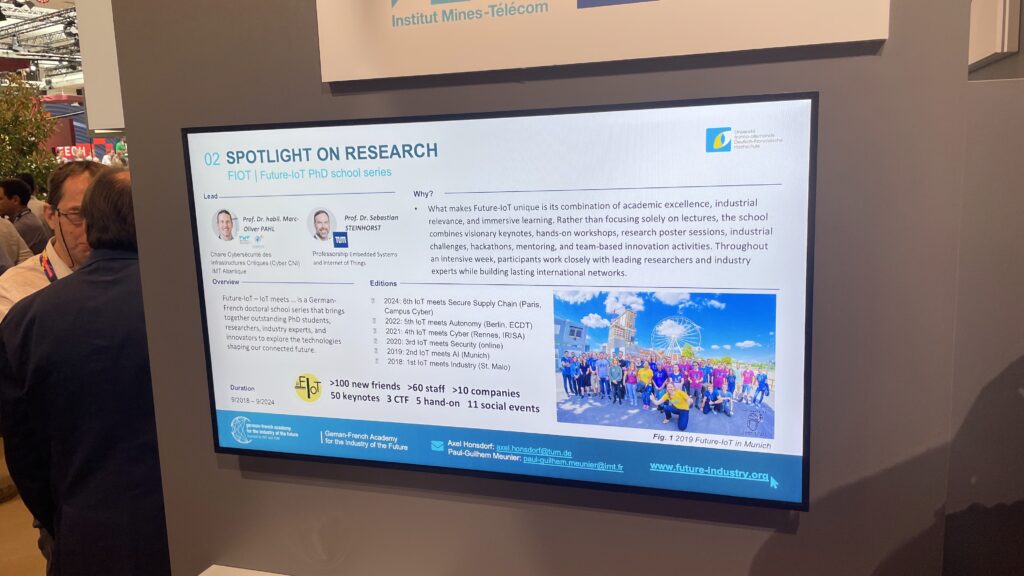
The Cyber CNI Chair contributes actively to advanced education through Future-IoT, one of the flagship doctoral schools of the German-French Academy for the Industry of the Future.
Founded in 2018 by Marc-Oliver Pahl and Nicolas Montavont and today co-organized by Marc-Oliver Pahl (IMT Atlantique) and Sebastian Steinhorst (Technical University of Munich), Future-IoT has become one of the leading doctoral training events of the Franco-German digital innovation ecosystem.
The school alternates between France and Germany and brings together doctoral researchers, industrial experts, entrepreneurs, and academic leaders from across Europe.
Its previous editions have explored topics including Industry 4.0, Artificial Intelligence, Cybersecurity, Autonomous Systems, and Secure Supply Chains.
By combining scientific excellence, industrial relevance, and community building, Future-IoT helps prepare the next generation of cybersecurity and digital technology leaders.
Cybersecurity Essentials: From Risk to Resilience
The second educational initiative presented at VivaTech was the MOOC Cybersecurity Essentials: From Risk to Resilience.
Developed within the framework of the German-French Academy with support from EDIH Bretagne, the course targets small and medium-sized enterprises, public organizations, and non-specialists seeking to strengthen their cybersecurity awareness and resilience.
By making cybersecurity knowledge accessible beyond technical experts, the initiative contributes directly to the broader resilience of the European digital ecosystem.
Building the Future Together
VivaTech 2026 highlighted an important reality: cybersecurity is no longer a specialized discipline operating at the margins of innovation.
It has become a fundamental enabler of digital transformation, industrial competitiveness, artificial intelligence, autonomous systems, and critical infrastructures.
At VivaTech, the Cyber CNI Chair demonstrated how cybersecurity research can move from visionary concepts to operational impact.
From making invisible digital interactions understandable through TRUE-VIEW, to validating cyber resilience through DTACK, and ultimately protecting critical infrastructures through CyberSecDome, the Chair continues to contribute to Europe’s digital sovereignty, resilience, and technological competitiveness.
Through research, education, innovation, and international collaboration, the Cyber CNI Chair remains committed to strengthening the cybersecurity of critical infrastructures and helping build a secure and trustworthy digital future for Europe.
Useful Links
- Learn more about the Cyber CNI Chair’s research activities.
- Discover our previous article on CyberSecDome.
- Read more about the Future-IoT doctoral school.
- VivaTech: https://www.vivatech.com
- German-French Academy for the Industry of the Future: https://www.gfa-fi.de
- IMT Atlantique: https://www.imt-atlantique.fr
- Cyber CNI Chair: https://cyber-cni.fr
- CyberSecDome: https://cybersecdome.eu
- Future-IoT: https://school.future-iot.org
- Future-IoT Community Blog: https://future-iot.org
- Cybersecurity Essentials MOOC: https://ilabxp.com/cybersecurity-essentials-from-risk-to-resilience/

Marc-Oliver is an adjunct professor of Carleton University in Canada. Marc-Oliver’s research focus is on a holistic approach to cybersecurity. He is an experienced teacher and an eLearning pioneer, holding several teaching awards.
Marc-Oliver holds a Diploma from University of Tübingen and a PhD from Technical University of Munich.
Marc-Oliver is Vice President of the German Chapter of the Association for Computing Machinery (ACM) (https://germany.acm.org/). He heads the Future Education activities of the German-French Academy for the Industry of the Future (https://future-industry.org/).
Marc-Oliver’s research focus is on a holistic approach to cybersecurity. He works on security-by-design, anomaly detection, human-in-the-loop, and automation. His goal is making cybersecurity manageable, resulting in highly resilient and reliable systems. Marc-Oliver publishes regularly in the network and service management and security communities.
- European Innovation Ecosystems: Lessons from Ten Years of the German-French Academy for the Industry of the Future - July 7, 2026
- France’s Cybersecurity Chairs Unite at the École Militaire: Strengthening a National Ecosystem for Cybersecurity Research - June 25, 2026
- Critical Infrastructure Cyber Resilience at Eurosatory 2026: Strengthening France’s and Europe’s Cyber Defence Ecosystem - June 24, 2026